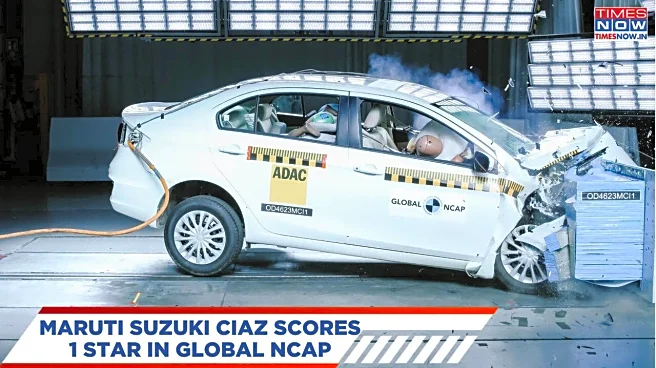

The Maruti Suzuki Ciaz has always been known in India as a comfortable, spacious and fuel-efficient sedan, which was popular among family buyers and office commuters. Though it is discontinued in India,
but still holds a space in global market. However, in its latest safety evaluation, the Ciaz has come under scrutiny after receiving a one-star safety rating in the 2025 Global NCAP crash test.
Global NCAP is an independent body that tests cars to see how well they protect passengers during crashes and cars are given star ratings based on how safe they are for adults and children in common accident scenarios. The higher the stars, the better the protection, but in the case of the Ciaz, Global NCAP awarded it one star for adult occupant protection, which is among the lowest ratings currently given.
Read: Ather Scooters To Get Costlier From January 2026 - Details Inside
One of the biggest concerns highlighted in the report was the structural strength of the car’s body. During the frontal offset crash test, Global NCAP found that the bodyshell and the footwell area of the car were unstable, which means the car’s structure may not hold up well if it faces a harder or higher-speed crash, reducing protection for occupants. Because the structure itself was rated unstable, the car could not score higher even if some safety features were present.
Another major issue was the absence of side head protection. The tested Ciaz does not come with curtain airbags, which protect passengers heads during side crashes. Due to this, the side pole impact test was not conducted, limiting the safety evaluation further and this is important because many serious injuries in real-world accidents happen during side impacts, especially in urban traffic.
Global NCAP also pointed out that the Ciaz does not offer three-point seatbelts for all seating positions, especially the rear middle seat. This means not every passenger gets equal protection, which affects both adult and child safety scores.
Even though the car offers electronic stability control (ESC) and seatbelt reminders for front occupants, safety for rear passengers remains a concern. Despite having some modern safety features, the combined effect of an unstable body structure, missing side head airbags, and incomplete seatbelt coverage resulted in the one-star rating.
Global NCAP concluded that the car offers limited protection in real-world crash situations, especially when compared to newer models with stronger structures and more airbags.
For more two wheeler, three wheeler and auto industry updates, stay tuned to Times Now Auto.


/images/ppid_59c68470-image-177102753183257032.webp)


/images/ppid_a911dc6a-image-17710264327998831.webp)

/images/ppid_a911dc6a-image-177102646607765106.webp)