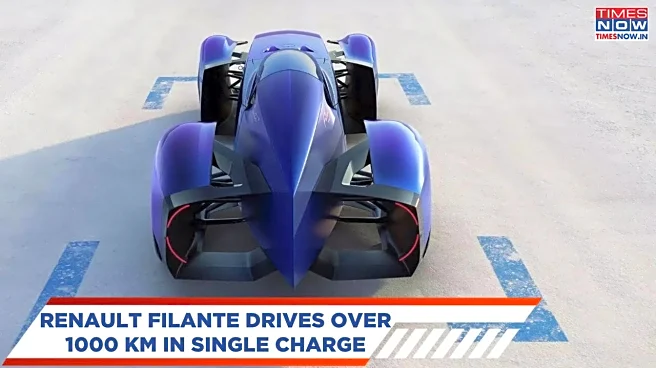

Renault has taken a big step in addressing one of the biggest issues around electric vehicles, which is the range anxiety, with its futuristic Filante Record 2025 concept electric car. In a certified long-distance
test, this experimental electric vehicle managed to travel 1,008 kilometres on a single charge, proving that electric cars can go far even at real-world highway speeds.
The test was performed on December 18, 2025, at UTAC’s test circuit in Morocco, under controlled conditions. Unlike many EV range demonstrations that focus on slow city driving, Renault wanted to test efficiency at continuous high speeds. The Filante Record 2025 completed the run in 9 hours and 52 minutes, maintaining an average speed of 102 kmph, which is similar to highway cruising speeds used by everyday drivers.
Also Read: Hyundai Creta Crosses 2 Lakh Sales In 2025, Becomes India’s Best-Selling SUV Again - Details Inside
The Filante Record 2025 is powered with an 87 kWh battery, which is the same size used in the production Renault Scenic E-Tech Electric. What makes this achievement more impressive is that Renault did not increase battery size to achieve the long range and after completing 1,008 km, the car still had around 11 percent battery charge left, which Renault estimates could allow it to travel an additional 120 km under similar conditions.
During the test, energy consumption was recorded at just 7.8 kWh per 100 km, which is extremely low for an electric vehicle driving at highway speeds and this efficiency was achieved mainly through advanced aerodynamics and weight reduction. The Filante Record 2025 weighs around 1,000 kg, due to the extensive use of carbon fibre and aluminium in its making.
Aerodynamics played a major role in this success, as Renault engineers used extensive wind tunnel testing to reduce the car’s drag coefficient from around 0.40 to 0.30. Design features such as a narrow body, enclosed wheel fairings, and reduced air intakes helped minimise air resistance, allowing the car to glide more efficiently at high speeds.
The concept car also serves as a testing platform for future technologies. It uses steer-by-wire and brake-by-wire systems, which replace traditional mechanical connections with electronic controls. Special low-rolling-resistance tyres were developed by Michelin, while motorsport specialist Ligier worked on the chassis, powertrain, and carbon structure.
Renault has made it clear that the Filante Record 2025 is not meant for production. Instead, it acts as a rolling laboratory to study how smart design, lightweight materials, and efficiency-focused engineering can extend real-world EV range without relying on larger batteries.
Speaking about the project, Sandeep Bhambra, Chief Designer Advanced Renault, said the goal was “absolute efficiency,” adding that the concept reflects Renault’s long tradition of innovation. The achievement sends a strong message: with the right technology, electric vehicles can comfortably handle long journeys, helping ease fears around charging and making EVs more practical for everyday use in the future.
/images/ppid_a911dc6a-image-177062914301599960.webp)

/images/ppid_a911dc6a-image-177062906270970776.webp)
/images/ppid_a911dc6a-image-177062910182760385.webp)
/images/ppid_a911dc6a-image-177062903119227507.webp)





/images/ppid_a911dc6a-image-177062863722831225.webp)