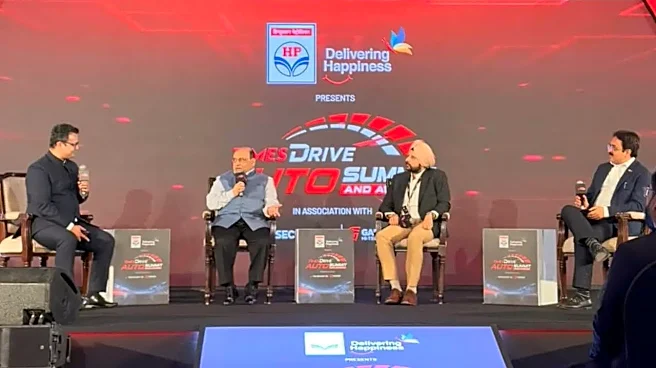



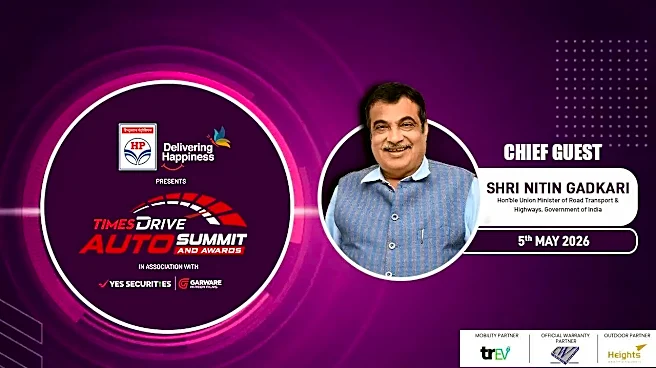
HPCL Presents Times Drive Auto Summit & Awards 2026 is currently taking place in New Delhi, India, and during the fireside chat on Future of India’s Auto Industry, What Fuels the Next Revolution?, key industry leaders across segments shared insights on the forces shaping the next phase of mobility. Experts from Toyota India, Qualcomm India, and the Automotive Skills Development Council discussed how clean energy, electric vehicles, and artificial intelligence are driving transformation in the sector. Here’s a quick look at the key highlights.
Vikram Gulati, Country Head & EVP, Toyota India
Vikram Gulati highlighted that that the direction of auto industry in India will be largely dominated by energy dynamics and sustainability goals.
He pointed to rising crude oil prices and India’s growing
import bill as key triggers accelerating the shift in the auto sector. As vehicle demand continues to surge, he highlighted the economic and environmental need to move towards cleaner energy alternatives. He explained that the future will see a combination of technologies, ranging from electric and hybrid vehicles to ethanol and gas-based fuels, working together to reduce dependence on fossil fuels.
He said, ''A significant share of crude energy is consumed by the automotive sector, which is currently witnessing phenomenal growth, supported by rapid infrastructure development and record-high sales in recent months. This makes it imperative for us to shift towards cleaner energy solutions at scale. The future of mobility will clearly be rooted in a sustainability-driven paradigm, where a mix of technologies, ranging from battery electric vehicles to ethanol and CNG, will shape the market going forward.”
Manmeet Singh, Head of Business, Auto, IEoT and CBN, Qualcomm India
While sharing his perspective on the next phase of India’s auto revolution, Manmeet talked about how software-defined vehicles are driving a major shift towards centralised, AI-powered architectures, and are moving away from traditional ECU-based systems. He explained that this new architecture supports faster innovation through cloud technologies like digital twins, continuous integration, and synthetic data-based AI training. He added that in the future AI will transform the in-car experience with smarter voice assistants, AI companions, and multimodal interfaces capable of understanding voice, text, and images. He also underlined the importance of AI in safety, with features like driver behaviour monitoring and real-time alerts set to make vehicles more intelligent and secure.
“The architecture in cars is changing, and eventually it will move to a completely AI-based architecture. AI is going to change how you see cars. We are moving towards a multimodal setup, where vehicles can understand voice, visuals, and context together. In a market like India, which is very chaotic, vision-based transformers become critical as they keep learning from driver behaviour. With rapid advancements in AI and chip technologies, we are already seeing very improved autonomy features coming in.”
Vinkesh Gulati, Chairperson, Automotive Skills Development Council
Vinkesh emphasised on the fact that while technology is rapidly advancing in the automotive sector, the bigger challenge for India lies in scaling and adoption. He pointed out that although the country has achieved high levels of localisation and capability in traditional manufacturing, it is still catching up in areas like EVs, hybrids, and advanced automotive technologies, with current readiness estimated at just 30–40%.
He also noted that customer acceptance remains a key hurdle, citing real-world examples where buyers often resist features like ADAS despite their safety benefits. Gulati added that the rapid pace of innovation is also creating a skills gap across dealerships and service networks, where technicians must now handle increasingly complex, tech-driven vehicles. To bridge this gap, he stressed the need for stronger collaboration between industry, academia, and training bodies, ensuring a steady pipeline of skilled talent that can keep pace with the evolving demands of next-generation mobility.
Also Read: Times Drive Auto Summit & Awards 2026: V V Muralikrishna Outlines HPCL’s Mobility Vision




/images/ppid_59c68470-image-177797502814461223.webp)

/images/ppid_59c68470-image-177797755964816943.webp)