
/images/ppid_a911dc6a-image-177072553694818011.webp)


TVS Motor Company has rolled out its third electric scooter in India: the Orbiter. Positioned as a youthful, tech-loaded urban runabout, it arrives at a sharp Rs 99,900 (ex-showroom, Bengaluru) and aims straight at Gen Z wallets and Instagram feeds. With the iQube already holding strong in the family segment and the premium X playing in a different league, the Orbiter wants to be the cool, no-nonsense daily driver for twenty-somethings who value features over flair. We spent a morning hustling it around TVS’s private test track to find out if the promise holds up on tarmac.
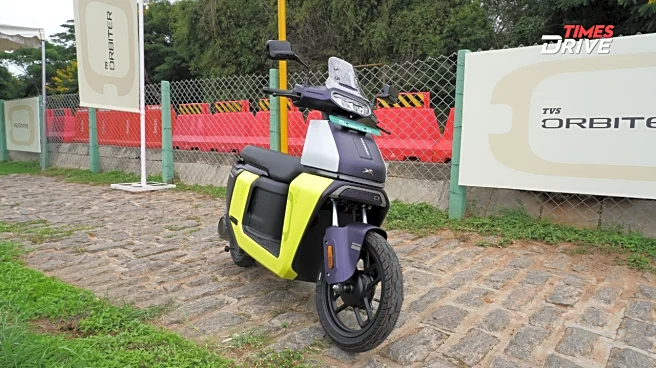
While most electric scooters try to look futuristic or aggressively sporty, the Orbiter takes the road less travelled: unapologetically boxy, almost retro-minimalist. Think
of it as the electric equivalent of a classic Honda Activa that grew up on energy drinks and smartphones. It’s a love-it-or-hate-it design that refuses to blend into the sea of curvy rivals, and honestly, that kind of confidence is refreshing in a segment full of similar designs.
Design and Features: Boxy Practicality Meets Smart Gadgets
Eschewing flashy curves, the Orbiter opts for a boxy, utilitarian form that's easy on the eyes for those who favour function over flair. The front boasts a broad LED headlamp with embedded DRLs and indicators, creating a cohesive, forward-facing presence complete with subtle Orbiter badging. From the side, minimalist graphics accentuate the flat seat and expansive floorboard, while the rear echoes the front with an integrated LED taillight. Telescopic forks smooth the front ride, twin shocks steady the rear, and the wheel combo: 14-inch front alloys with a quirky pattern, 12-inch rear cradling the BLDC hub motor, lends a distinctive stance.
Drum brakes in rear and front, backed by CBS, provide adequate stopping power for the 68 kmph top speed, though enthusiasts might yearn for discs. With 165 mm ground clearance and a 783 mm seat, it's approachable, and the 34-litre boot offers ample space for two half-helmets or groceries: a boon for practical souls. The 5.5-inch colour LCD cluster keeps you informed with battery stats, trip data, and distance to empty, plus Eco and City modes for versatile riding. Standouts include hill hold for inclines, cruise control from 20-22 kmph, park assist for reversing out of jams, navigation, Bluetooth connectivity, and crash notifications: a thoughtful suite that feels premium at this level, though integration could be smoother.
Performance: Composed Urban Glide, With Room for Refinement
A 3.1 kWh pack powers the 2.5 kW motor, churning out 120 Nm torque for unhurried city sprints that prioritise efficiency over fireworks. It nudges to 40 kmph steadily, with Eco limiting to 46-48 kmph for range conservation and City freeing up to 68 kmph. The claimed 158 km IDC range translates to solid daily coverage, though real tests would confirm longevity.
On the track, handling shone in twists, the setup fostering agile turns and stable lines. However, the footboard's confines pinched for my taller build; those over 5'8" may feel hemmed in. Cruise control hummed along reliably, and hill hold engaged seamlessly, underscoring its city credentials. It's dependable for stop-go traffic but lacks the punch for spirited escapes.
Verdict: Practical Orbit for City Dwellers, But Check Your Fit
First glances at the Orbiter's stark design may enchant or underwhelm, hinging on personal taste; it's direct, not dazzling. Minor drawbacks like cramped space and basic brakes temper enthusiasm, yet the value from features, range, and pricing bolsters its case for urban Gen Z. For pure city duties, it circles success; highway ventures call for broader horizons. TVS delivers a grounded EV contender, balancing promise with pragmatism.