

/images/ppid_59c68470-image-177078503256226273.webp)
Sudden Flat Tyre On The Road? Here are 6 things you should do first and why it matters. With increasing highway speeds, heavier vehicles and more congested urban roads, what was once a minor inconvenience has now turned into a matter of great concern for people, especially in India. The risk profile has changed: modern traffic does not offer much room for error when there is some unexpected tyre failure. In the crucial first few seconds, driver decisions can impart safety as well as repair costs and even insurance outcomes. Here are the six most important things to do right after facing a flat tyre on real-world driving conditions in India that we're going to focus on. We will not focus on mechanical theory but, instead, on minimising risk including
the mistakes most people make and understanding why these steps are vital to everyday car owners.
Also Read: 2026 KTM 200 Duke Arrives At Dealerships With New Colour — What Stands Out For Buyers
Stay Calm And Slow Down Gradually
- Most people's first instincts on getting a flat tyre is to slam the brakes. This will further destabilise the vehicle especially if one is cruising at highway speeds.
- Grip has been reduced unevenly across the tyres so applying the brakes suddenly increases the chances of losing control.
- It is better to ease off and let the car slow down by itself.
- Predictable deceleration gives other traffic time to react and takes stress off the remaining tyres.
Move To A Safe Stopping Spot
- It is more hazardous to stop suddenly in an active lane than it is to drive slowly for a short distance.
- Try to get onto the road shoulder, service lane, or some well-lit area where you can stop further ahead.
- In Indian traffic conditions, this also reduces your exposure to fast-moving trucks and two-wheelers.
- Remember, the priority is safety first not tyre preservation.
Switch On Hazard Lights Immediately
- Hazard lights indicate to other road users that the vehicle is not running under normal conditions.
- In any condition of low visibility or high traffic, hazard lights go a long way in preventing rear-end collisions.
- It becomes very important on Indian roads due to erratic lane discipline; proper signalling has to be ensured.
Secure The Vehicle Before Stepping Out
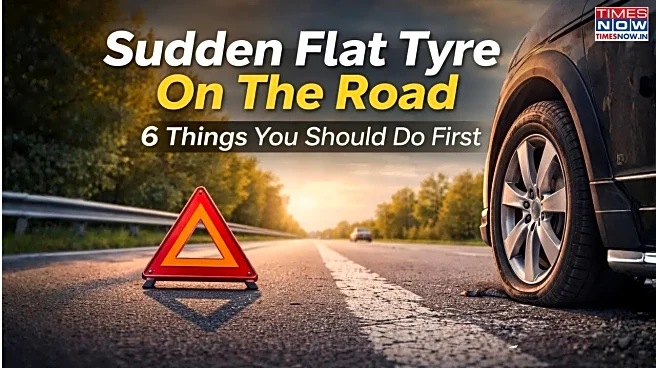
- If you meet with a roadside problem, engage the handbrake, switch off the engine, and set up a warning triangle if you have one.
- Most of the injuries on the road do not take place during the initial problem-for example a puncture-but when the driver is outside the vehicle.
- This acts as an immediate visible safety buffer around your car and thus enhances your protection as well as that of other road user.
Assess Repair Options Realistically
- A roadside fix does not work for every flat tyre.
- Some problems like sidewall damage, cracks in alloy wheels, and so on cannot be fixed by just roadside mending.
- In fact, in most cases of repeated punctures it is better to let the professionals handle it when to call roadside assistance can prevent further damages and even higher repair cost later on.
Also Read: 5 Heavy Duty Bikes You Can Buy Instead Of Royal Enfield Hunter 350
Drive Conservatively After A Temporary Fix
- Using a spare tyre or the puncture repair kit means altering driving behaviour.
- Temporary spares have speed and distance limitations.
- Damages that result from not heeding these limitations will void warranties since parts of suspension components can be damaged.
- This last step is very important as it protects your vehicle and your finances.
Always follow these steps when facing a flat tyre to ensure the safety of you and your car both.





/images/ppid_59c68470-image-177078525111865682.webp)

/images/ppid_59c68470-image-177078503270811955.webp)
/images/ppid_59c68470-image-177078521601960697.webp)
/images/ppid_59c68470-image-177078509411559643.webp)
/images/ppid_59c68470-image-177078515326856199.webp)
/images/ppid_59c68470-image-177078512573843468.webp)