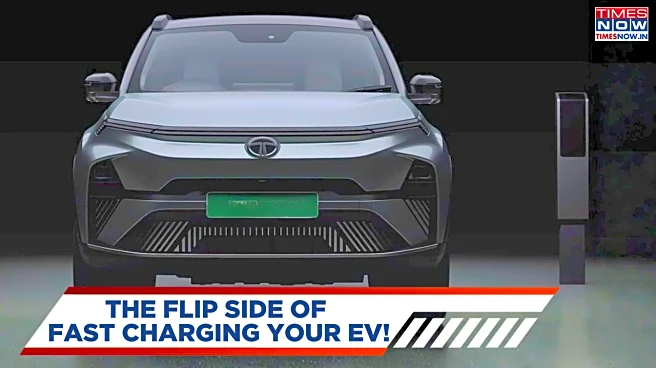

Range anxiety has been a fundamental roadblock in the mass adoption of electric vehicles (EVs) across the country and manufacturers compensate for the issue by offering fast-charging capability in their
vehicles. With the average mid-sized EV offering battery packs of 30 kWh to 45 kWh capacity, commonly found DC fast chargers of up to 50 kW promise to cut the charging time considerably for EV drivers on the move. However, the flip side to that convenience is that EV owners end up paying 2 to 3 times more in charging costs for using public fast-chargers. Here's a quick breakdown and cost comparison.
For our comparison, we will consider the costs of a user who drives a base variant Tata Nexon EV that comes with a 30 kWh battery pack. Considering residential electricity unit rates range between Rs 6 and Rs 10 across different states, a full charge of a 30 kWh battery should cost Rs 240, at an average cost of Rs 8 per kWh. This further translates to a running cost of Rs 0.80 per km for a standard Nexon EV.
These costs dramatically rise when using public fast chargers of both AC and DC types. Public DC fast chargers typically come under three categories. A 25 kW capacity fast-charger costs Rs 16 to Rs 18 per kWh of charge on average, a 50 kW fast-charger would cost Rs 18 to Rs 22 per kWh charge on average and the per kWh price for using a 150 kW super-charger can go up to Rs 22 to Rs 25 per unit.
Considering the 50 kWh fast-charger as a commonly found, time-effective option, this would take the cost of charging a 30 kWh battery from 0-100 percent to Rs 600 at an average rate of Rs 20 per kWh. Compared to the Rs 240 spent on home charging, the cost of using the fast charger is approximately 2.5 times more and potentially brings the running cost of the same EV to up to Rs 3.8 per km, which is a considerable hike. This margin also continues to grow as you move towards more powerful DC fast-chargers.
Also Read: Petrol vs Hybrid Mileage And Cost Comparison Of Maruti Suzuki Victoris, Honda City eHEV And More
Bottom line, while public DC fast charging can considerably reduce charging periods, they also cost a lot more. For EV users who rely on fast charging more frequently, this eats into the running cost benefits that are a fundamental benefit of moving to an all-electric car. While the running cost might still be cheaper than petrol or diesel, it is still recommended to prioritise home charging to benefit from standardised residential electricity rates and recoup the extra investment made when choosing an electric vehicle instead of an ICE vehicle.
/images/ppid_59c68470-image-177061003540471716.webp)




/images/ppid_a911dc6a-image-177060805827282660.webp)

/images/ppid_a911dc6a-image-177060802858924218.webp)
/images/ppid_a911dc6a-image-177060803566643240.webp)
/images/ppid_a911dc6a-image-177060802130265096.webp)
/images/ppid_59c68470-image-177060764201711364.webp)
/images/ppid_59c68470-image-177060752986769970.webp)
/images/ppid_59c68470-image-17706076747273736.webp)