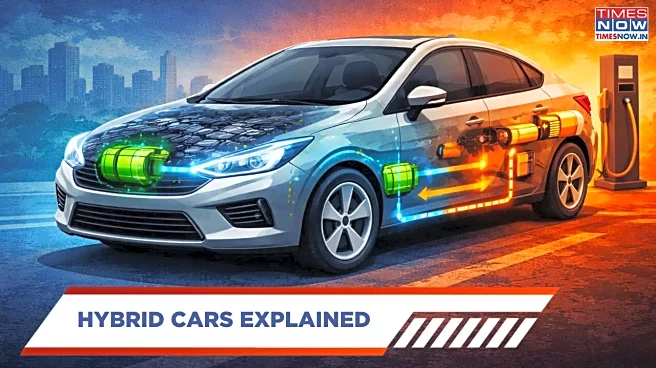




Hybrid technology in cars refers to systems that combine a conventional internal combustion engine with one or more electric motors. This approach is designed to improve fuel efficiency, reduce tailpipe emissions and optimise power delivery compared with traditional petrol or diesel-only vehicles. Hybrids store and use electrical energy through a battery pack, which works in tandem with the engine during acceleration, cruising and braking. Different hybrid systems vary in complexity and capability, but all share the core principle of using electric propulsion to reduce reliance on the internal combustion engine. Understanding how hybrids work helps buyers evaluate their benefits and limitations.
Also Read: China Bans Hidden Car Door Handles For
Road Safety - Should India Be Next?
How Hybrid Cars Work
At its core, a hybrid car uses both an internal combustion engine and an electric motor to drive the wheels. The electric motor draws power from a high-voltage battery that is recharged through regenerative braking and in some cases, by the engine itself. When the car accelerates from a standstill or during low-speed driving, the electric motor can provide propulsion without engaging the engine, which reduces fuel use. At higher speeds or under heavy load, the internal combustion engine works alongside the electric motor. The system automatically switches between power sources based on driving conditions to optimise efficiency.
Types Of Hybrid Systems
There are several types of hybrid technologies used in cars:
- Full Hybrid: Can drive the vehicle using the engine, the electric motor, or both together. This allows significant electric-only driving under certain conditions.
- Mild Hybrid: Uses an electric motor to assist the engine but cannot power the car on electricity alone. The motor helps with start-stop functions and low-load acceleration.
- Plug-In Hybrid (PHEV): Features a larger battery that can be charged from an external power source and allows longer electric-only driving range.
Each system balances cost, complexity and efficiency differently, with plug-in hybrids typically offering the greatest electric range.
Benefits And Limitations
Hybrid technology improves fuel economy by reducing how much the engine runs, particularly in city driving with frequent stops and starts. Regenerative braking captures energy that would otherwise be lost, converting it into electrical power stored in the battery. Lower emissions are a related benefit, especially compared with conventional engines. However, hybrids are generally more expensive than non-hybrid equivalents due to added components like electric motors and battery packs. Long-term ownership costs can be influenced by battery health and replacement expenses.
Also Read: 5 Seater Hybrid Cars In India - 2026 Renault Duster, Maruti Suzuki Victoris And More
Hybrid Cars And The Future
Hybrid technology represents a transitional step toward full electrification in the automotive industry. While electric vehicles eliminate tailpipe emissions entirely, hybrids offer many efficiency benefits without requiring changed charging infrastructure. They remain a practical choice for drivers who seek improved fuel economy and reduced emissions without fully committing to all-electric mobility. As battery technology and system integration advance, hybrid systems continue to evolve with better performance and wider adoption.
/images/ppid_a911dc6a-image-177060805827282660.webp)

/images/ppid_a911dc6a-image-177060802858924218.webp)
/images/ppid_a911dc6a-image-177060803566643240.webp)
/images/ppid_a911dc6a-image-177060802130265096.webp)
/images/ppid_59c68470-image-177060764201711364.webp)

/images/ppid_59c68470-image-177060752986769970.webp)
/images/ppid_59c68470-image-17706076747273736.webp)
/images/ppid_59c68470-image-177060756212923902.webp)
/images/ppid_59c68470-image-177060756327762255.webp)
/images/ppid_59c68470-image-177060753405348279.webp)