
/images/ppid_a911dc6a-image-178045563458582097.webp)
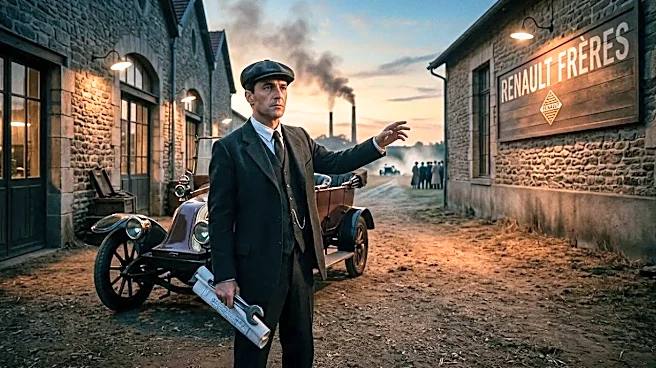
Louis Renault built his first car in his parents' garden in 1898. He was 21. On New Year's Eve that year, he drove it up a steep hill in Paris on a bet, and took twelve orders on the spot. That was the incident that started one of Europe's largest car companies. But the moment that actually changed what Renault became happened five years later on a road in Spain, when Louis watched his brother Marcel's car hit a dust cloud at close to 160 km/h and never come out the other side.
The Race That Ended Everything
The 1903 Paris-Madrid race was chaos from the start. Over 1,300 kilometres of public road, barely cleared of civilians. No barriers. Spectators standing at the edge of the tarmac. Dust so thick from the cars ahead that drivers could not see more than a few metres in front
of them. The fastest cars were hitting 140 kmph on open road sections — extraordinary for 1903, and lethal in those conditions.
Marcel Renault was one of the fastest drivers in Europe. He and Louis had driven every major race together. Between Poitiers and Angoulême, Marcel's car hit deep sand at full speed, left the road and flipped. He never regained consciousness.
The French government stopped the race before it reached Madrid. Eight people died that day — drivers, mechanics, spectators. The cars were escorted back to Paris under military guard. It remains the deadliest motorsport event in history.
Louis was somewhere on that road when it happened. He found his brother. He withdrew from the race. He was 26 years old and he never competed again.
What He Did Next
Most people who go through something like that slow down. Louis Renault did the opposite. Within two years of Marcel's death, Renault was supplying taxis to Paris — the Renault AG1, the same car that would carry 6,000 French soldiers to the Battle of the Marne in 1914. The French army took every available Paris taxi and drove troops to the front line in them. It was the first time motor vehicles changed the outcome of a battle. Renault's cars did it.
By 1914 the company had over 4,000 workers. By the end of WW1 that number was 22,500. Renault built the FT tank — the first modern tank with a fully rotating turret — along with aircraft engines, ambulances and staff cars.
Louis essentially ran France's wartime industrial output from his factory in Billancourt. People who worked alongside him in those years described someone who was never still. He walked the factory floor at night by himself. He could not stop working. Whether that was ambition or grief wearing the mask of ambition, nobody could quite tell from the outside.
The Brother Everyone Forgets
There is a detail that gets left out of most Renault histories. It was not just Marcel. Fernand Renault — the eldest of the three brothers — was the one who had turned Louis's New Year's Eve orders into an actual company. Louis had the engineering mind. Fernand had the commercial sense. He structured the partnerships, handled the money and gave the whole operation its early stability. Without Fernand, Louis's garden shed invention probably stays a garden shed invention.
Fernand died of illness in 1909. Six years after Marcel. Louis was 32. Both brothers were gone. The company that had started as a three-way partnership — Louis building things, his brothers running everything else — was now entirely his. He had not planned that. He had not asked for it. What he had wanted was Marcel in the passenger seat at the next race. What he ended up with was sole ownership of one of Europe's most important industrial companies, a factory employing tens of thousands of people, and nobody left from the original three who started it.
Renault sold around 23 lakh cars last year. Marcel has a grave in France and a single line in most motorsport histories. The two facts exist in completely different versions of the same story and almost nobody thinks to connect them.

/images/ppid_59c68470-image-178045752932527997.webp)

/images/ppid_59c68470-image-178045756371054365.webp)
/images/ppid_59c68470-image-178045759677076208.webp)
/images/ppid_59c68470-image-178045753038263420.webp)
/images/ppid_59c68470-image-178045752774556041.webp)
/images/ppid_a911dc6a-image-178045706086588722.webp)

/images/ppid_a911dc6a-image-178045702926118652.webp)