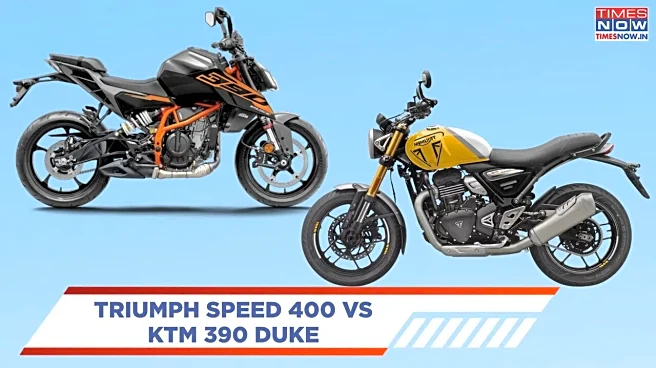

The Triumph Speed 400 and KTM 390 Duke are two closely matched motorcycles in India’s mid-capacity naked bike segment. Both target riders seeking modern design, strong performance, and everyday usability,
but they approach this goal very differently. While the Speed 400 follows a more restrained roadster layout focused on balance and comfort, the 390 Duke adopts a sharper, more aggressive setup aimed at enthusiastic riding. This comparison looks at the key specification differences between the two, covering chassis hardware, suspension, braking systems, features, and overall positioning to understand what truly sets them apart.
Also Read: Delhi Ends GRAP 4 Vehicle Restrictions — How It Affects BS4 Petrol Vehicles
Triumph Speed 400 Vs KTM 390 Duke: Engine And Performance Differences
The Triumph Speed 400 uses a liquid-cooled 398.15cc DOHC single-cylinder engine, producing about 39.5 hp at 8,000 rpm and 37.5 Nm at 6,500 rpm. It is designed for smooth throttle response and balanced performance. The KTM 390 Duke’s 398.63cc engine makes more power, around 45.37 hp at 8,500 rpm and 39 Nm at 6,500 rpm, giving it the edge in outright performance. This difference influences acceleration and high-speed ability, making the Duke feel more aggressive in dynamic riding.
Triumph Speed 400 Vs KTM 390 Duke: Chassis, Suspension And Handling
Both motorcycles use steel trellis frames with a sporty stance, but handling character differs. The KTM 390 Duke typically has fully adjustable front forks and rear suspension settings, which allow riders to fine-tune ride dynamics for aggressive cornering. The Triumph Speed 400 uses an upside-down front fork and rear mono-shock tuned for balanced comfort and stability. The Duke’s sharper chassis setup generally feels more agile in twisty riding, while the Speed 400 leans towards stable and planted handling suited for relaxed road use.
Triumph Speed 400 Vs KTM 390 Duke: Braking And Safety Features
Braking hardware on both bikes includes disc brakes at the front and rear with dual-channel ABS. The KTM 390 Duke’s setup includes a larger front disc and radial caliper that typically delivers stronger stopping power and better feedback under hard braking. The Speed 400’s brakes are well-matched to its performance level but are tuned more for everyday stability than track-focused deceleration. Both benefit from traction control and rider aids appropriate for their power levels.
Triumph Speed 400 Vs KTM 390 Duke: Dimensions And Ergonomics
The Triumph Speed 400 and KTM 390 Duke share similar wheelbase and overall footprint, but small differences affect rider feel. The Speed 400’s seat height is slightly lower, aiding accessibility for a variety of rider heights, while the Duke’s slightly taller stance suits more aggressive posture. Kerb weights are in the same ballpark, meaning both bikes offer manageable mass for urban and highway riding. Fuel capacities are close, though minor variations may influence range.
Also Read: New Renault Duster SUV Teased Ahead Of January 26 India Launch
Triumph Speed 400 Vs KTM 390 Duke: Features And Pricing
Feature lists on both motorcycles include modern digital instrument clusters, slipper clutches, and advanced safety systems. The Duke often leads on aggressive performance-oriented features and adjustable suspension components. The Speed 400 prioritises a refined ride with rider aids tailored for balanced usability. Ex-showroom pricing for the Speed 400 stands at Rs 2.34 lakh, whereas for the 390 Duke, it is Rs 2.97 lakh.



/images/ppid_a911dc6a-image-177098609283733676.webp)

/images/ppid_a911dc6a-image-177098604430638966.webp)
/images/ppid_a911dc6a-image-177098617669599604.webp)
/images/ppid_a911dc6a-image-177098602618035982.webp)