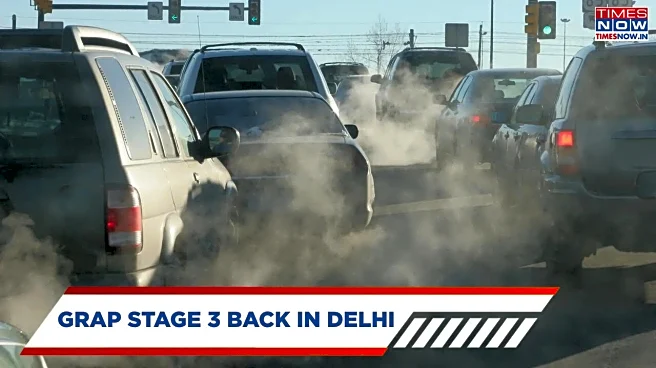

Commission for Air Quality Management (CAQM) has reinstated GRAP Stage 3 measures in Delhi after the city’s Air Quality Index once again crossed the 400 mark, entering the ‘Severe’ category. The restrictions
are part of the Graded Response Action Plan, activated whenever pollution levels rise sharply. With Stage 3 back in force, several rules now apply to vehicle movement, construction activity as well as industrial operations. For car owners, the latest update outlines what types of vehicles are allowed, which ones face curbs, and the penalties for violations. Here’s a detailed, fact-based breakdown of the current car-related rules under GRAP Stage 3 in Delhi.
Also Read: BMW 5 Series Long Wheelbase Updated For India — What’s New
What GRAP Stage 3 Means For Car Owners
The GRAP Stage 3 rules do not completely ban private vehicle movement, but they do impose specific curbs depending on vehicle type and fuel category. Petrol and diesel cars are still allowed on the roads. However, restrictions are tightened for older vehicles and commercial fleets. The directive aims to lower vehicular emissions during periods when pollution spikes beyond emergency thresholds.
Cars Allowed Under GRAP Stage 3
Private petrol and diesel cars registered in Delhi or neighbouring NCR states continue to be permitted. Public transport, CNG vehicles, electric cars and BS6-compliant vehicles face no additional restrictions. Taxis and app-based aggregators are also allowed to operate, provided the vehicles are compliant with existing emission norms. Movement into Delhi from neighbouring cities is also permitted unless the vehicle falls under specific prohibited categories.
Cars Facing Restrictions Or Bans
Under Stage 3, the rule that remains consistently enforced is the ban on diesel four-wheelers that are not BS6-compliant. Older diesel cars (BS3, BS4, BS5) are not allowed to operate within Delhi during this phase, regardless of vehicle category. Certain commercial vehicles may also face entry restrictions during peak pollution periods, as directed by local authorities. These curbs are aimed at reducing the emission load from high-polluting diesel models.
Penalties For Violations
The GRAP Stage 3 comes with strict enforcement, and violations can lead to substantial penalties for both private motorists and commercial fleets.
- Driving BS-III petrol or BS-IV diesel vehicles during this phase can trigger action under the Motor Vehicles Act.
- Penalties may reach Rs 20,000, and authorities have the power to seize non-compliant vehicles.
- Cars without a valid PUC certificate can attract fines of up to Rs 10,000, so timely renewal is important.
- Delhi Police and the Transport Department have increased field checks and are using digital tools to identify violators and reduce unnecessary vehicle movement while pollution remains severe.
- Stage 4 has not been invoked yet, but vehicle owners should monitor updates in case stricter restrictions are introduced.
Also Read: Mini Cooper S Convertible Launched In India — Will It Be The Last Of Its Kind?
Current Situation And Monitoring
Stage 3 will continue until air quality improves consistently and the Commission for Air Quality Management (CAQM) issues a rollback order. Pollution levels continue to fluctuate, and authorities monitor AQI trends daily before modifying restrictions.
/images/ppid_a911dc6a-image-177071311265874579.webp)

/images/ppid_a911dc6a-image-177071314953421767.webp)
/images/ppid_a911dc6a-image-177071307920887358.webp)
/images/ppid_a911dc6a-image-177071303076331213.webp)





/images/ppid_59c68470-image-177071258499638831.webp)
