
/images/ppid_59c68470-image-178062758540474775.webp)
/images/ppid_a911dc6a-image-178056203226116955.webp)
Carl Benz was born in 1844 in Germany. His father died before he turned two, and his mother raised him with almost no money. His birth name was not even Benz — he came into the world as Carl Friedrich Michael Vaillant. His mother changed the surname to keep his father's memory alive. To help at home, young Karl fixed watches and clocks on the side, and later set up a makeshift darkroom in the Black Forest developing photos for tourists. Talented with machines. Hopeless with everything else.
He got a mechanical engineering degree in 1864 and spent years moving between jobs before setting up an iron foundry in Mannheim with a partner named August Ritter. Ritter turned out to be useless. The business started falling apart almost from day one. Karl
was heading for complete financial ruin before he had done anything significant.
His fiancée Bertha Ringer stepped in. She used her personal dowry — money she controlled before they were even married — to buy Ritter out and pull the company back from the edge. Without that, there is no car. No company. No Mercedes-Benz. Most people have no idea this happened.
He Built the First Car — Then Kept It Hidden in a Workshop
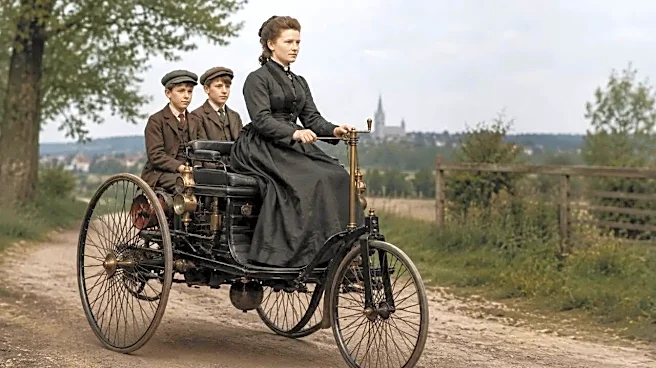
With the business no longer sinking, Carl turned back to what he had been thinking about since his student days — a self-powered carriage. He had been inspired by cycling, by the efficiency of it, and wanted to replicate that with an engine. By 1885 he had built the Benz Patent-Motorwagen — three wheels, a single-cylinder engine, all his own engineering. He did not do what other inventors were doing, which was taking an existing horse carriage and sticking an engine on it. He designed a vehicle from scratch, built around the engine. On January 29, 1886, he got patent DRP No. 37435 — the document most historians point to as the moment the automobile was officially born.
Nobody cared. The church called it the devil's work. The German government banned it from public roads. Newspapers wrote it off. At one public demonstration it was so hard to steer it drove straight into a wall. About 25 units sold over several years. That was it.
Mercedes-Benz's own historical records describe Carl as self-doubting, obstinate, and sullen. He kept disappearing into the workshop, adjusting things, never feeling ready to put the car properly in front of the world. Bertha had watched this for two years. She had put in her own money, sat beside him through every test run, and knew the mechanics as well as he did. She was finished waiting.
The Morning She Took the Car Without Asking
On August 5, 1888, Bertha got up before Carl. She woke their two teenage sons — Eugen, 15, and Richard, 13. She left a note on the table saying they were going to visit her mother in Pforzheim. Then they went into the workshop, pushed the Motorwagen down the road in silence so the engine noise would not wake Carl, and left.
No roads built for cars. No filling stations. No mechanics anywhere. Just Bertha and two teenagers in a machine that had mostly been laughed at.
The trip was 106 km. The fuel pipe got blocked — she cleared it with a hat pin. The ignition insulation failed — she fixed it with her garter. The brakes ground down on a hill — she stopped at a shoemaker, had leather fitted on the spot, and in doing so invented brake pads. She refuelled at a pharmacy in Wiesloch that sold a petroleum-based cleaning solvent — without knowing it, the pharmacy became the first petrol station in history.
She finished the journey, sent Carl a telegram, then drove back the next day on a different route to test more road conditions.
After that, people paid attention. Orders came in. The company lived. Carl later wrote: "Only one person remained with me in the small ship of life when it seemed destined to sink. That was my wife."
Benz & Company merged with Daimler in 1926 to form Mercedes-Benz. Carl was alive to see it but had no significant part in running it. He died in 1929 at 84. Bertha made it to 1944. They are the only husband and wife ever inducted into the Automotive Hall of Fame — both of them.