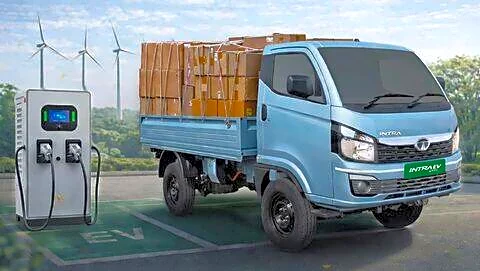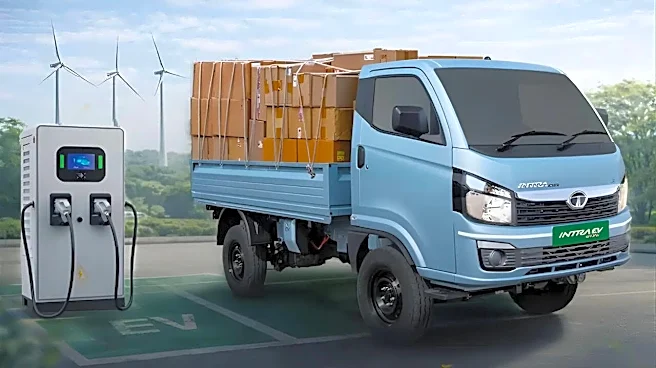


Tata Motors has launched the Tata Intra EV in India at Rs 11.95 lakh (ex-showroom). This EV brings a 28.2 kWh battery, 211 km range as well as 1,750 kg payload into the small commercial vehicle space. That combination directly targets daily business use and not just electric adoption. On the surface, it’s another EV launch. But this one is for operators who care less about tech and more about running cost, load capacity and reliability. That’s where the real shift begins. Let's get into the details now.
Battery, Motor And Performance: Tuned For Work Cycles
The Tata Intra EV is powered by a 28.2 kWh lithium-ion battery pack which is paired with a permanent magnet synchronous motor producing around 97 hp and 230 Nm of torque. It delivers a claimed range of 211 km. This essentially aligns closely with typical
intra-city delivery cycles.
The vehicle also supports fast charging, with 10-80% charge achievable in around 55 minutes, making turnaround times more manageable for fleet operations. With a top speed of around 80 km/h, the focus is clearly on controlled, efficient movement instead of just highway performance.
Payload, Dimensions And Hardware: Built For Utility
Where the Intra EV stands out is its 1,750 kg payload capacity which is supported by a gross vehicle weight of 3,320 kg. It uses a rigid suspension setup with parabolic leaf springs at both ends, designed to handle consistent load conditions.
The pickup measures around 4,734 mm in length with a 2,600 mm wheelbase and offers a practical cargo area while staying manageable in urban environments. Braking is handled through a disc front and drum rear setup, tuned for stability under load rather than aggressive stopping.
Also Read: Tata Sierra Mileage Revealed Via RTI – Real Numbers May Surprise You
What It Means For Buyers And Operators
The Intra EV isn’t trying to replace diesel overnight, it’s trying to make a strong case where usage is predictable. For businesses running fixed routes, the 211 km range is usable without range anxiety. The real advantage comes from lower running and maintenance costs especially in high-utilisation scenarios.
It also signals something bigger. Electric vehicles are moving into segments where uptime, payload and cost per kilometre matter the most. That’s where adoption becomes practical, and not just aspirational.