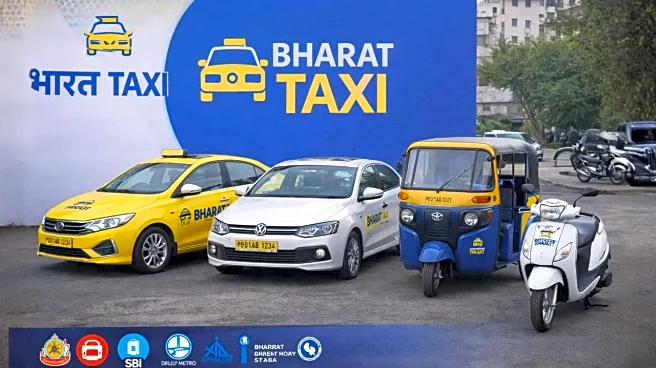



India’s taxi space has a new entrant and it’s rewriting the rules as Bharat Taxi, launched by Amit Shah, has been introduced as the country’s first cooperative-based taxi aggregator which is meant to shift ownership and profits toward the people who actually drive the cars.
The launch event, attended by officials from the Ministry of Cooperation and representatives from multiple states, drew more than 1,200 drivers which are called “Sarathis”, signalling early interest from the workforce the platform is designed to empower.
Model
Bharat Taxi’s idea is simply that the drivers are shareholders. Each ‘Sarathi’ contributes a fixed share to join the cooperative, gaining ownership and a voice in how the platform is run. Decisions are made through elected
representatives on the board and profits are shared among driver-members, with a portion retained to keep the service running smoothly.
This is a sharp departure from traditional app-based taxi services, where drivers often shoulder commissions, incentives change frequently and decision-making is done by the apps.
Payments
Perhaps the biggest talking point is what Bharat Taxi doesn’t do, as the platform does not deduct commissions or levy booking fees. When a passenger pays, the fare goes straight to the driver’s bank account. For drivers, that means predictable earnings and fewer surprises at the end of the day. For riders, it promises transparency as what you pay is what the driver earns.
Also Read: Hyundai i20 Gets New Era Variant For Under Rs 6 Lakh, Higher Variants Get More Affordable
Coverage, vehicle choice and a clear expansion plan
Bharat Taxi is starting small but thinking big as it currently operates in Delhi-NCR and parts of Gujarat, offering two-wheelers, three-wheelers and four-wheelers. Officials say the goal is nationwide coverage within three years, with a focus on city hubs and last-mile connectivity.
“Sarathi Didi” - a women-first option
A dedicated category called “Sarathi Didi” allows women passengers to book rides driven by women. The option will be available within the app, aimed at improving comfort and safety while creating more earning opportunities for women drivers.
Social security for gig workers
Bharat Taxi is also tying its model to gig worker welfare as the drivers can access benefits linked to government schemes, including health coverage up to Rs 5 lakh, insurance options and pathways to loans and subsidies. Registration via the e-Shram portal is facilitated, which brings informal workers closer to formal protections.
Partnerships
To make the ecosystem work, Bharat Taxi has signed MoUs with nine institutions, including Delhi Traffic Police, Delhi Metro Rail Corporation, Airports Authority of India, State Bank of India, and the National e-Governance Division. These partnerships span airport operations, last-mile connectivity, digital integration, insurance, and vehicle financing.
Why this launch matters
Bharat Taxi isn’t just another app, but it is a structural rethink of ride-hailing in India. By aligning incentives with drivers, removing commissions and adding social security, it aims to prove that growth and fairness don’t have to be opposites. Whether it scales nationwide will depend on execution, but the direction is clear- ownership over algorithms, people over percentages.