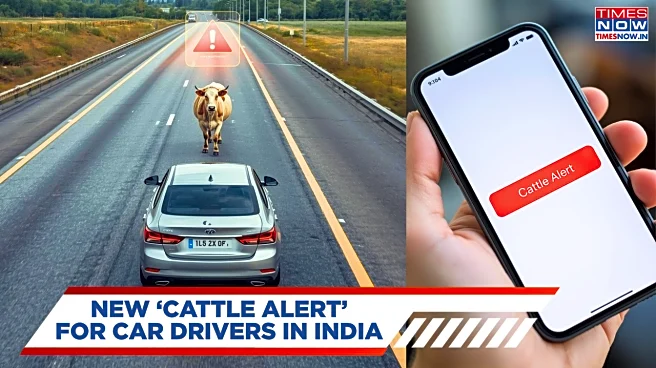




In a bid to reduce accidents on highway roads, the National Highways Authority of India has launched a 'Stray Cattle Alert' pilot programme under its 'Road Safety Month 2026' initiatives. In collaboration with telecom providers, NHAI is testing a real-time 'cattle alert' system that will notify vehicle drivers of stray cattle on national highways and reduce the risk of accidents, particularly in foggy or low visibility conditions. Here's what we know so far.
The system would work by leveraging telecommunication and drivers will be notified of stray cattle movement via a cellular-based Flash SMS alert, which will be followed up by a voice alert saying the same message/alert. Highway commuters will be sent a cattle alert warning in advance, approximately
10 km before they enter a zone that has been identified as a high-risk stretch. This would alert the drivers and allow them a lead in distance and time to prepare and take caution.
As a part of road safety initiatives to commemorate #RoadSafetyMonth 2026, #NHAI, in collaboration with telecom service providers, launched a pilot initiative to deliver real-time safety alerts to National Highway users approaching stray cattle–prone zones. The initiative is… pic.twitter.com/8dvWUeGSxj
— NHAI (@NHAI_Official) January 14, 2026
The NHAI is currently testing a pilot programme for the cattle alert system on the Jaipur-Agra and Jaipur-Rewari national highway stretches, as these have been identified as high-risk zones for cattle. Drivers would first receive the Flash SMS in Hindi saying, 'आगेआवारा पशु ग्रस्त क्षेत्र है। कृपया धीरे और सावधानी से चलें।', which would also be followed up with a voice alert in the same language. NHAI will further ensure that the cattle alert is not repeated for the same user within a 30-minute window to avoid any alert fatigue to drivers.
Also Read: Cars To Give Crash Warnings To Each Other - How Nitin Gadkari's New V2V Technology Works?
NHAI is currently mapping high cattle-risk zones based on both historical data and on-field inputs. Based on the results of the pilot programme, the NHAI will decide if the system will be expanded to other high-risk zones. This announcement comes a week after it was revealed that the government is developing a telecom-based OBU system, which will enable vehicles to communicate with each other in low-visibility situations and help prevent accidents on national highways. The system would alert drivers of stationary cars ahead and would not be based on the vehicle's radar safety systems, making it applicable to all cars and increasing safety on a larger scale.




/images/ppid_a911dc6a-image-177048213382190467.webp)

/images/ppid_a911dc6a-image-177048209962229350.webp)
/images/ppid_a911dc6a-image-177048203548351117.webp)
/images/ppid_a911dc6a-image-177048206764992452.webp)