
India is currently the world's third-largest car market and Maruti Suzuki is currently the largest carmaker in the country. As new electric vehicles flood the market, it is natural for car buyers to wonder
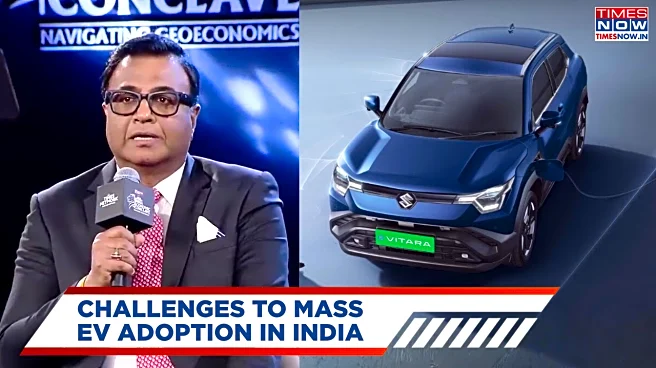
why the automaker has yet to enter the electric vehicle segment with its own rival that would offer a solution to the several bottlenecks associated with EV adoption. At the recently held India Economic Conclave 2025, Partho Banerjee, Senior Executive Officer, Marketing and Sales, Maruti Suzuki India Limited, shared some key insights on the matter.
Also Read: Indian Women In Sarees Inspired Hyundai's Tall Hatch Design - Tarun Garg At IEC 2025
WATCH | Partho Banerjee, Senior Executive Officer, Marketing and Sales, Maruti Suzuki India Limited, in conversation with @AyeshaFaridi1.@IDFCFIRSTBank #IEC2025 #INDIAECONOMICCONCLAVE pic.twitter.com/dxm0QezLqp
— TIMES NOW (@TimesNow) December 18, 2025
Addressing several questions around EV adoption and when Maruti Suzuki plans to start its own electric car journey, Banerjee stated, 'Today if we talk about the EV, we, being the market leader feel it is very important for us to have a play in all form factors and also to have a play across all the sectors and also the technologies. Be it the EVs, the hybrids, ICE and even CNG. Because you cannot be a market leader if you are not offering all types of products and you are not catering to all segments.' Maruti Suzuki currently has an extensive portfolio of cars that range from entry-level economy hatchbacks to luxury hybrid MPVs, however, an all-electric model has been missing from the portfolio despite the e-Vitara production being underway in India.
According to Partho Banerjee, while there is a good influx of new electric cars in the market, Maruti Suzuki is more focused on addressing the concerns of its loyal customers, rather than early adopters of the technology. 'Today, there are more than 17 to 18 models in the EV segment, including the ones that are doing some numbers. But the EV penetration of the total industry is just 4 percent. So, it does not make too much of a difference in a country like ours, where we are selling close to 4 lakh cars every month. Just 4 percent is around 16,000–17,000 cars. What is the reason? Why are people not adapting to the EV? That is a very fundamental question. So, we are lucky that many of our friends in the industry have launched their EVs. From there, we had some learnings and from the customers, we came to know that there are certain concerns in their minds. Till the time we can address that, we will only get the early adopters, but we will not get the mass movement for the electric vehicle.' Banerjee said at the forum.
Elaborating on the inhibitions that customers are facing towards mass EV adoption, Banerjee pointed out that fundamentally, four things came out.
1. The range of the vehicle -
'Now what has happened in the past, the products which have been offered to the Indian customers - the range claimed versus the real-world range, there was a huge gap. So now the customers are a little concerned and thinking if the OEMs are claiming some range, in reality how much I will get?'
2. They were not buying this car as the primary car -
'Not the first car in their house. The reason was very simple, In India the car penetration ratio is at 34 per 1,000 and the customer who is buying their first car, is not buying it thinking, if I have to go out of the city, I will be using another car and within the city if I’m traveling, I will be using the EV. The customer wants a practical car - if he wants to go to Chandigarh or Jaipur, it should do that. At the same time, when I’m in town, I will be able to use that vehicle every day. Now, if you don’t have a good public charging system, he will not be able to use it if he is going out of the city.'
3. After-sales service -
'How good the product is? At the end of the day, you need to give a good after-sales service. It is very important. Technology is fine, but you need an after-sales service network.'
4. Resale value -
'Which is very important. After five years, I want to change the car and get another car, what is the resale value that I will get? Now, if you talk about today, the conventional ICE vehicles, after five years, you get at least 50 percent as the salvage price. So what is the amount that I can expect after five years? Because EVs, generally people know has a battery. And if the battery after five years' life is going down, then what is the price that I will get?'
With this list of compelling points, Partho Banerjee reiterated that only when Maruti Suzuki or any other carmaker can address these four concerns, EV adoption will not reach its tipping point in terms of mass acceptance. He also assured the forum that Maruti Suzuki is currently working on addressing all issues surrounding EV ownership before launching the new e-Vitara electric SUV in the country.
On December 2, Maruti Suzuki had announced its strategy to tackle the issue of 'range anxiety' amongst first-time EV buyers. The carmakers have already set up 2,000 exclusive EV charging points nationwide, covering over 1,100 cities. In addition to this, Maruti Suzuki has also partnered up with 13 Charge Point Operators (CPOs) in a bid to offer a large charging ecosystem to its e-Vitara customers. Overall, the carmaker plans to achieve its goal of 1 lakh EV chargers across the country by 2030 by leveraging both CPO and dealer partner networks.
Keep reading Times Now Auto for more instant updates on all new SUV launches in India.


/images/ppid_a911dc6a-image-177098609283733676.webp)

/images/ppid_a911dc6a-image-177098604430638966.webp)
/images/ppid_a911dc6a-image-177098617669599604.webp)
/images/ppid_a911dc6a-image-177098602618035982.webp)