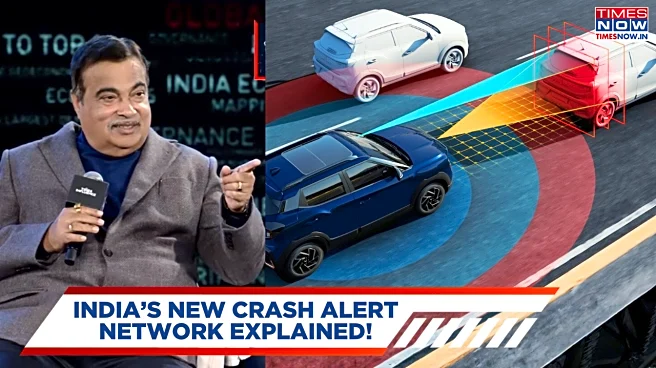

India plans to implement a new system of wireless communication between cars driving on the roads. The system is designed to increase road safety by enabling nearby vehicles to give crash alert signals
to each other during low visibility and other harmful scenarios. The new Vehicle-To-Vehicle (V2V) technology roll-out has been planned by the end of 2026 and will cost an estimated Rs 5,000 crore to be implemented. Here's what we know so far.
'Vehicle-to-Vehicle Communication System (V2V)' वाहनों के बीच संवाद स्थापित कर ड्राइवर को सतर्क करेगी।#RoadSafety #SadakSurakshaAbhiyaan #सड़कसुरक्षाअभियान pic.twitter.com/ipM79GTctn
— Nitin Gadkari (@nitin_gadkari) January 9, 2026
The safety initiative was announced at the State Road Transport Ministers' Annual Meeting by Union Road Transport Minister, Nitin Gadkari. He explained that the wireless communication system lets vehicles on the road communicate in real-time and give crash alerts. This would be helpful in low visibility scenarios, such as fog and also prevent incidents such as a crash due to a vehicle parked in the middle of the road.
To enable the feature, an On-Board Unit (OBU) will be added to vehicles that will exchange data with other vehicles wirelessly. It will be a SIM card-based system, which means it will rely on mobile networks instead of the radar-based information that high-end cars with ADAS systems currently use to avoid a crash. The V2V system monitors vehicle speed, location, acceleration and braking in real-time and gives an early warning to drivers in order to avoid a crash at any blind spot.
Also Read: MoRTH Proposes Aadhaar-Like ID System For EV Batteries To Track Their Entire Life Cycle
The SIM-based system will be chargeable to drivers, however, no price-related details have been disclosed yet. We can expect the ministry to notify the V2V technology by the end of 2026, before a phased implementation starting with new cars. It is also expected to be easily compatible with ADAS-enabled cars that are growing in market share. While the benefits of the system are clear, it also throws up the concern of data privacy for car drivers. Considering that the OBU device tracks key data points such as vehicle speed, location, acceleration and braking in real-time, the government would also need to plan a robust data protection policy to ensure the off-road safety of car owners.



/images/ppid_a911dc6a-image-177084603066450478.webp)





/images/ppid_a911dc6a-image-177084257810510483.webp)
/images/ppid_a911dc6a-image-177084253417916956.webp)

/images/ppid_59c68470-image-177084004043125742.webp)
