









What is the story about?
The Ministry of Petroleum and Natural Gas has informed the Rajya Sabha that the government has not received any widespread or substantiated complaints from vehicle manufacturers, automobile associations or consumer organisations regarding engine failure, fuel pump issues, corrosion, water contamination or other performance problems attributable to E20 fuel. The ministry also said that no decision has been taken to increase ethanol blending with petrol beyond 20%.
Responding to a series of questions on E20 fuel, including its impact on blending, procurement, consumer choice and vehicle performance, the ministry said, "So far, no decision has been taken by the Government for increasing ethanol blending with petrol beyond 20%. Any future decision regarding higher ethanol blends will be taken only after detailed scientific and technical studies and consultations with all relevant stakeholders, including automobile manufacturers, Oil Marketing Companies and research institutions.
"The premise that E20 is a new or suddenly introduced fuel is not correct. Ethanol has been used as a transport fuel globally for over a century, and India's Ethanol Blended Petrol (EBP) Programme commenced with a pilot in 2001. Before each increase in the blending level, studies were undertaken in consultation with NITI Aayog, the Automotive Research Association of India (ARAI), the Society of Indian Automobile Manufacturers (SIAM), the Indian Institute of Petroleum (IIP), Oil Marketing Companies and automobile manufacturers.
"These included laboratory testing, durability trials and field validation covering engine durability, material compatibility, fuel systems, corrosion resistance, drivability, emissions, fuel efficiency and overall vehicle performance. E20-compatible vehicles are certified only after undergoing the prescribed homologation process, while the impact on existing vehicles was also evaluated before nationwide implementation.
"The scientific findings have since been reinforced through extensive real-world experience. E15+ blended petrol has been in widespread use for over three-and-a-half years and E19-E20 fuel for more than two-and-a-half years. More than 20 crore two-wheelers and over 3 crore petrol cars, including a large number of older vehicles manufactured before E20 certification, have been operating on these fuels without any verified evidence of widespread engine failure or vehicle breakdown attributable to ethanol blending.
"Had E20 caused systemic damage to vehicle performance or longevity, it would have been reflected in large-scale warranty claims and service records, which has not been observed."
"Manufacturers continue to honour warranty obligations for vehicles using specification-compliant E20 fuel. With regard to efficiency, studies indicate that fuel economy depends on several factors, including driving conditions, driving habits and vehicle maintenance. Mileage depends on driving habits, tyre pressure, servicing and AC load far more than fuel type. Any reduction in fuel economy in certain older E10-designed vehicles is generally limited to about 3-5%, while E20 offers a higher octane rating, superior anti-knock characteristics, cleaner combustion and smoother engine operation," the ministry added.
According to the ministry, the transition to E20 has also delivered significant national benefits. The Ethanol Blended Petrol Programme has saved more than ₹1.97 lakh crore in foreign exchange, substituted nearly 316 lakh metric tonnes of crude oil, reduced around 952 lakh metric tonnes of CO₂ emissions, and transferred over ₹1.66 lakh crore to farmers.
Responding to a separate query on the impact of E20-blended petrol on vehicle performance, the ministry said vehicle manufacturers were consulted at every stage of the transition from E10 to E20, and extensive laboratory studies and field trials were conducted before the rollout.
"Had automobile manufacturers not been fully satisfied with the results, they would neither have certified E20-compatible vehicles nor honoured warranty obligations. The fact that manufacturers continue to honour warranties for vehicles running on specification-compliant E20 fuel reflects their confidence in the scientific validation and testing undertaken.
"The Government has not received any widespread or substantiated complaints from vehicle manufacturers, automobile associations or consumer organisations regarding engine failure, fuel pump issues, corrosion, water contamination or other performance issues attributable to E20 fuel. The Government has, however, taken note of certain concerns raised in the media and on social media, which have been scientifically examined," the ministry said.
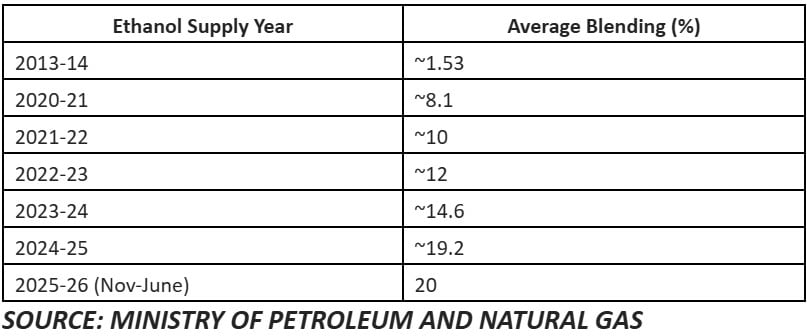
Responding to a series of questions on E20 fuel, including its impact on blending, procurement, consumer choice and vehicle performance, the ministry said, "So far, no decision has been taken by the Government for increasing ethanol blending with petrol beyond 20%. Any future decision regarding higher ethanol blends will be taken only after detailed scientific and technical studies and consultations with all relevant stakeholders, including automobile manufacturers, Oil Marketing Companies and research institutions.
"The premise that E20 is a new or suddenly introduced fuel is not correct. Ethanol has been used as a transport fuel globally for over a century, and India's Ethanol Blended Petrol (EBP) Programme commenced with a pilot in 2001. Before each increase in the blending level, studies were undertaken in consultation with NITI Aayog, the Automotive Research Association of India (ARAI), the Society of Indian Automobile Manufacturers (SIAM), the Indian Institute of Petroleum (IIP), Oil Marketing Companies and automobile manufacturers.
"These included laboratory testing, durability trials and field validation covering engine durability, material compatibility, fuel systems, corrosion resistance, drivability, emissions, fuel efficiency and overall vehicle performance. E20-compatible vehicles are certified only after undergoing the prescribed homologation process, while the impact on existing vehicles was also evaluated before nationwide implementation.
"The scientific findings have since been reinforced through extensive real-world experience. E15+ blended petrol has been in widespread use for over three-and-a-half years and E19-E20 fuel for more than two-and-a-half years. More than 20 crore two-wheelers and over 3 crore petrol cars, including a large number of older vehicles manufactured before E20 certification, have been operating on these fuels without any verified evidence of widespread engine failure or vehicle breakdown attributable to ethanol blending.
"Had E20 caused systemic damage to vehicle performance or longevity, it would have been reflected in large-scale warranty claims and service records, which has not been observed."
"Manufacturers continue to honour warranty obligations for vehicles using specification-compliant E20 fuel. With regard to efficiency, studies indicate that fuel economy depends on several factors, including driving conditions, driving habits and vehicle maintenance. Mileage depends on driving habits, tyre pressure, servicing and AC load far more than fuel type. Any reduction in fuel economy in certain older E10-designed vehicles is generally limited to about 3-5%, while E20 offers a higher octane rating, superior anti-knock characteristics, cleaner combustion and smoother engine operation," the ministry added.
According to the ministry, the transition to E20 has also delivered significant national benefits. The Ethanol Blended Petrol Programme has saved more than ₹1.97 lakh crore in foreign exchange, substituted nearly 316 lakh metric tonnes of crude oil, reduced around 952 lakh metric tonnes of CO₂ emissions, and transferred over ₹1.66 lakh crore to farmers.
Responding to a separate query on the impact of E20-blended petrol on vehicle performance, the ministry said vehicle manufacturers were consulted at every stage of the transition from E10 to E20, and extensive laboratory studies and field trials were conducted before the rollout.
"Had automobile manufacturers not been fully satisfied with the results, they would neither have certified E20-compatible vehicles nor honoured warranty obligations. The fact that manufacturers continue to honour warranties for vehicles running on specification-compliant E20 fuel reflects their confidence in the scientific validation and testing undertaken.
"The Government has not received any widespread or substantiated complaints from vehicle manufacturers, automobile associations or consumer organisations regarding engine failure, fuel pump issues, corrosion, water contamination or other performance issues attributable to E20 fuel. The Government has, however, taken note of certain concerns raised in the media and on social media, which have been scientifically examined," the ministry said.