






Cooking's Nutrient Impact
It's a widespread belief that microwave ovens decimate the nutritional value of food, a concern amplified by the convenience they offer. However, scientific
evidence suggests a different story. All methods of cooking, whether on a stovetop, in an oven, or via microwave, inevitably alter the chemical composition of nutrients to some degree. The key differentiator among these methods isn't whether nutrients are affected, but rather the extent and speed of their degradation. Interestingly, when compared to prolonged cooking processes, microwaving's efficiency often leads to better nutrient retention, challenging the prevailing notion that it's inherently detrimental to food's health benefits. This understanding is crucial for making informed dietary choices and dispelling common anxieties surrounding everyday kitchen appliances.
Microwave Speed Advantage
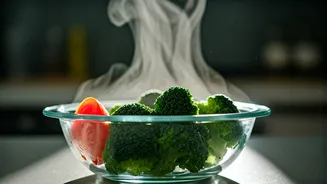
The core principle behind microwave cooking's nutrient-preserving capabilities lies in its speed. Unlike conventional cooking methods that often require extended periods of high heat exposure, microwaves rapidly heat food by exciting water molecules within it. This accelerated process means that heat-sensitive vitamins, such as Vitamin C and various B vitamins (like thiamin and riboflavin), are exposed to high temperatures for a significantly shorter duration. Consequently, there's less opportunity for these delicate nutrients to break down and be lost. Furthermore, microwaving typically uses less water than methods like boiling. Nutrients that are water-soluble can easily leach into cooking water, which is then often discarded. By minimizing water usage, microwaving helps to keep more of these valuable nutrients within the food itself, leading to a more nutritionally intact final product compared to traditional water-based cooking techniques.
Research Backs Efficiency
Multiple scientific investigations corroborate the idea that microwave reheating is surprisingly effective at retaining nutrients. A comprehensive review of various studies indicates that microwave cooking often results in nutrient retention that is either equal to or even superior to conventional reheating methods. Specific vitamins, including the crucial B vitamins like thiamin and riboflavin, along with Vitamin C, have been observed to be well-preserved when food is reheated using a microwave. In many instances, the nutritional profile of food reheated in a microwave is found to be remarkably comparable to that of freshly prepared meals. This finding is significant, suggesting that enjoying leftover meals warmed in a microwave doesn't come with a substantial sacrifice in terms of their inherent nutritional value. The speed of heating, reduced water usage, and overall lower heat exposure contribute to this favorable outcome.
Factors Affecting Nutrients
While microwaves themselves aren't inherently destructive to nutrients, certain factors can still lead to nutrient loss during reheating, though these issues are not exclusive to microwave ovens. Overheating food, regardless of the method, can degrade nutrient content. Uneven heating, which can sometimes occur in microwaves, might also impact the overall quality and nutrient distribution in the food. Additionally, repeatedly reheating the same portion of food over time can contribute to a gradual decline in its nutritional value. Therefore, the primary determinants of nutrient preservation are not the appliance itself but rather the duration of heating, the amount of water involved in the process, and the frequency with which food is reheated. The microwave, by its nature, often minimizes these detrimental factors, making it a sound choice for reheating.
Microwaves: Not the Villain
In conclusion, the perception of microwave ovens as nutrient destroyers is largely a myth. While no cooking method is entirely perfect and nutrient profiles will inevitably change with any form of heat application, microwaves stand out for their efficiency. They offer a fast cooking time, require minimal water, and in many comparative studies, have demonstrated a capacity to preserve nutrients better than traditional methods like boiling or frying. The science suggests that reheating your meals in a microwave is a perfectly acceptable way to retain their nutritional benefits. What truly matters are the cooking time, the water quantity used, and how many times the food is reheated, rather than the microwave as the sole culprit for any perceived nutrient loss. It’s a practical and often nutrient-friendly kitchen tool.