
Induction Cooktops Under ₹2,000.
Tested With Pressure Cooker, Kadai, and Tawa
LPG prices keep rising. Induction cooktops under ₹2,000 seem like a great backup. But can they actually handle a pressure cooker? A heavy kadai? A flat tawa for roti? We checked. Here's what worked, what didn't, and which ones are worth buying.
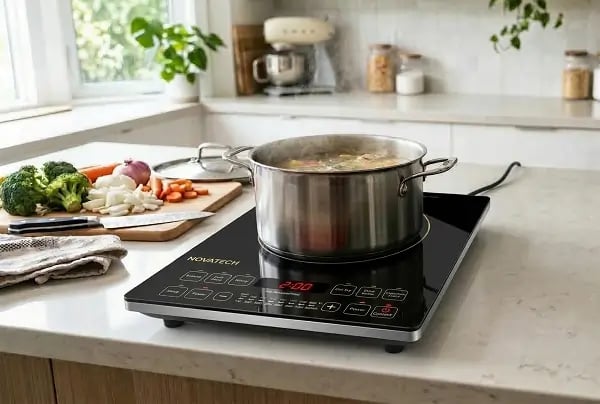
You've seen the prices at Flipkart and Amazon. Induction cooktops starting at ₹1,200. Some at ₹1,500. A few decent-looking ones at ₹1,999.
The specs sound fine. 1800W. Crystal glass top. 7 preset menus. Auto shut-off.
But you have one real question. Can it actually handle Indian cooking?
Not boiling water. Not reheating milk. Real cooking. Pressure cooker dal. A heavy kadai with oil for deep frying. A flat tawa for roti or dosa.
That's what this article is about. We looked at the most popular induction cooktops under ₹2,000 available in India right now. We checked how they handle real Indian utensils. And we found one problem that nobody warns you about before you buy.
The One Thing Nobody Tells You Before Buying

Here it is, upfront.
Your aluminium pressure cooker will not work on an induction cooktop.
This is the single biggest reason people return induction cooktops in India. They buy the cooktop, put their existing aluminium cooker on it, and nothing happens. No heat. No error message on some models. Just nothing.
Induction cooktops work by creating a magnetic field. That field heats the cookware directly. But it only works with magnetic metals like stainless steel and cast iron.
Aluminium is not magnetic. Neither is copper. Neither is regular glass.
Most Indian kitchens have aluminium pressure cookers. They've been the default for decades. If that's what you have at home, it won't work on induction.
The magnet test (do this before buying)
Take a fridge magnet. Hold it against the bottom of your pressure cooker, kadai, or tawa.
- If the magnet sticks firmly: The utensil will work on induction.
- If the magnet slides off or barely holds: It won't work. You'll need to buy induction-compatible cookware.
This takes 10 seconds and can save you the frustration of a cooktop that "doesn't heat."
What works on induction:
- Stainless steel pressure cookers (must have a flat, magnetic base)
- Cast iron kadais and tawas
- Triply cookware (stainless steel + aluminium + magnetic steel layered together)
- Any cookware labelled "induction compatible" or marked with a coil symbol on the base
What doesn't work:
- Aluminium pressure cookers (the standard Prestige/Hawkins aluminium ones)
- Aluminium kadais
- Copper-bottom vessels
- Round-bottom woks (the base must be flat to make contact with the cooktop)
- Regular non-stick pans without an induction-compatible base
Budget tip: If you're buying an induction cooktop for the first time, factor in the cost of at least one induction-compatible pressure cooker (₹800 to ₹1,500) and one flat-bottom kadai or tawa (₹400 to ₹800). Your real budget isn't just the cooktop. It's the cooktop plus compatible utensils.
Induction Cooktops Under ₹2,000: What's Available Right Now
Here are the models that are widely available on Amazon and Flipkart in India as of March 2026. Prices change daily, so check both platforms before buying.
Pigeon by Stovekraft Cruise
- Price: ~₹1,299 to ₹1,499
- Wattage: 1800W
- Controls: Push button
- Presets: 7 cooking modes
- Safety: Auto shut-off, overheat protection
This is the most popular entry-level induction cooktop in India. Pigeon (owned by Stovekraft) has the widest distribution network of any induction brand. Push-button controls are more durable than touch panels, especially with wet hands during cooking. At 1800W, it handles pressure cooking, boiling, frying, and simmering without complaint.
Best for: First-time buyers, hostel rooms, PG accommodations, budget-conscious families.
Prestige PIC 20
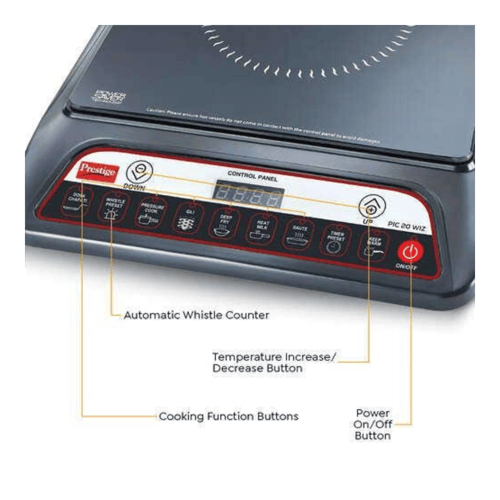
- Price: ~₹1,199 to ₹1,499
- Wattage: 1600W
- Controls: Push button
- Presets: Indian menu options
- Safety: Auto shut-off, anti-magnetic wall
Prestige is one of the most trusted kitchen brands in India. The PIC 20 is their entry-level offering. At 1600W, it's the lowest power option on this list. That matters if you live in an older apartment with limited wiring capacity or if you run multiple appliances at the same time.
It's also the most compact and lightweight option. Easy to store and move between rooms.
Best for: Small kitchens, PGs, studio apartments, and homes with limited circuit capacity.
iBELL 30YO
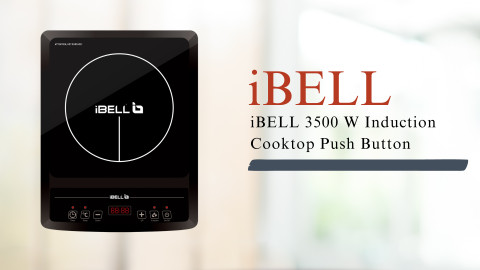
- Price: ~₹1,390
- Wattage: 2000W
- Controls: Push button
- Safety: Auto cut-off, overheat protection
At 2000W for under ₹1,400, this is the best power-to-price ratio on this list. Push-button controls, crystal glass top, and basic safety features.
However, iBELL is not as established as Prestige or Pigeon. Their service network relies on third-party providers. If the cooktop breaks down, getting it repaired may be harder depending on your city.
Best for: Buyers who want maximum wattage at minimum cost and are okay with a less established brand.
Bajaj Majesty ICX 3

- Price: ~₹1,399 to ₹1,599
- Wattage: 1900W
- Controls: Push button
- Safety: Voltage protection, auto shut-off
Bajaj carries a strong reputation for handling Indian voltage fluctuations. If you live in a Tier 2 or Tier 3 city where power supply is inconsistent, this matters. The built-in voltage stabilisation helps the cooktop maintain consistent heating even when power fluctuates.
Best for: Homes with unstable power supply, Tier 2/3 cities.
Havells Insta Cook PT

- Price: ~₹1,599 to ₹1,899
- Wattage: 1600W
- Controls: Push button
- Presets: 7 preset functions (milk heating to deep frying)
- Safety: Pan detection, auto shut-off
Havells builds this noticeably more robustly than the Pigeon or Bajaj at similar prices. The auto pan detection feature only activates the cooktop when it detects a compatible vessel. This prevents accidental activation and saves power.
Best for: Buyers who want long-term durability and are willing to pay slightly more within the ₹2,000 range.
Usha CookJoy 2000W

- Price: ~₹1,999
- Wattage: 2000W
- Controls: Touch
- Presets: 8 Indian preset cooking modes (dosa, chapati, curry, etc.)
- Safety: Pan sensor technology, child lock, smart pause
At the top of the ₹2,000 budget. Touch controls instead of push buttons. 8 Indian preset modes cover staples like dosa, chapati, and curry. The child lock and smart pause are useful safety additions.
Usha has nationwide service centres, so repairs are easier than with smaller brands.
Best for: Families who want a full-featured cooktop at the upper end of the budget, with reliable after-sales service.
How They Handle Real Indian Cooking
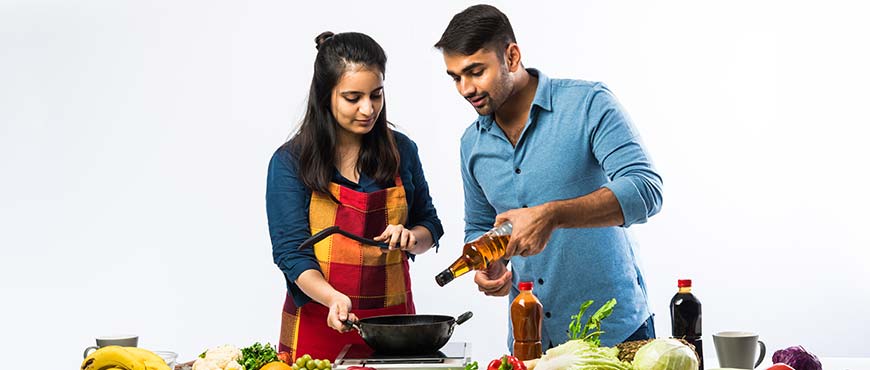
Here's what actually matters. Not the spec sheet. The cooking.
Pressure cooker test

A 3-litre stainless steel pressure cooker with dal and water.
At 1800W to 2000W, the cooktop brings the cooker to first whistle in about 8 to 10 minutes. That's noticeably faster than a typical gas stove, which takes 12 to 15 minutes for the same quantity.
At 1600W (Prestige PIC 20, Havells Insta Cook PT), the first whistle takes 12 to 14 minutes. Slower, but still functional. If you pressure-cook large quantities daily, go for 1800W or above.
Key point: The cooker must have a flat, magnetic base. If it wobbles on the glass surface, the cooktop may flash an error or refuse to heat. A stable, flat-bottom cooker is essential.
Kadai test
A medium stainless steel kadai with oil for deep frying pakoras.
All models heated the oil to frying temperature within 5 to 7 minutes at full power. The higher-wattage models (1900W to 2000W) were about 1 to 2 minutes faster.
One thing to watch: cast iron kadais work on induction, but they heat up slower than stainless steel. Cast iron retains heat longer once hot, so it's great for even cooking but takes patience on the initial heat-up.
If your kadai has a round bottom (traditional style), it won't sit flat on the induction surface. You need a flat-bottom kadai. Most induction-compatible kadais sold online are flat-bottomed for this reason.
Tawa test (roti and dosa)

A flat iron tawa for roti.
This is where lower-wattage models struggle slightly. At 1600W, the tawa takes longer to heat evenly across the surface. Roti puffs better on a well-heated tawa, so the first 2 to 3 rotis may not puff as well until the tawa reaches full temperature.
At 1800W to 2000W, the tawa heats evenly within 3 to 4 minutes and maintains consistent temperature.
For dosa, a flat non-stick dosa tawa with an induction-compatible base works well across all wattage levels. Dosa doesn't need as much heat as roti, so even 1600W models handle it fine.
Key point: The tawa diameter matters. If the tawa is too small (less than 12 cm), some cooktops won't detect it. If it's too large and overhangs the coil area significantly, heating will be uneven. A 25 cm to 28 cm flat tawa is the ideal size for most portable induction cooktops.
Push Button vs Touch Panel: Which Lasts Longer?
At this price range, most models use push buttons. That's actually a good thing.
Touch panels look sleek. But at the ₹1,200 to ₹2,000 range, the touch panels used are basic and prone to malfunction over time. Especially in Indian kitchens where steam, water splashes, and oil are common.
Push buttons work with wet hands. They don't malfunction from steam. And they're cheaper to repair if something breaks.
The Pigeon Cruise, Prestige PIC 20, iBELL, Bajaj, and Havells all use push buttons. The Usha CookJoy is the only touch-panel model on this list.
If durability matters more than aesthetics, go with push buttons.
Electricity Cost: Is It Really Cheaper Than Gas?
This is the question everyone asks.
A 2000W induction cooktop running at full power for 1 hour consumes 2 units (kWh) of electricity.
At the average Indian electricity tariff of ₹6 to ₹8 per unit, that's ₹12 to ₹16 per hour of full-power cooking.
But most cooking sessions last 20 to 40 minutes, not a full hour. So your actual daily cooking cost is roughly ₹8 to ₹20 per day.
Compare that to an LPG cylinder. A 14.2 kg domestic cylinder costs ₹900 or more in most cities and lasts 25 to 30 days for a typical family. That's about ₹30 to ₹36 per day.
So induction cooking can save you ₹10 to ₹20 per day, depending on how much you cook. Over a month, that's ₹300 to ₹600 in savings.
The cooktop pays for itself within 2 to 4 months in LPG savings alone.
However: Induction needs electricity. If you have frequent power cuts, you can't cook. Most families keep their gas stove as a backup and use induction as the primary cooking method for daily meals.
Voltage Fluctuation: Will the Cooktop Survive?
Voltage fluctuation is a real concern in many parts of India. Especially in Tier 2 and Tier 3 cities, and in areas with inconsistent power supply.
Most induction cooktops in this price range come with basic surge protection (usually 4kV). This handles minor fluctuations.
If you live in an area with major voltage swings, do one of these:
- Buy the Bajaj Majesty ICX 3, which has built-in voltage stabilisation designed for Indian conditions.
- Use an external voltage stabiliser (₹500 to ₹1,000) between the wall socket and the cooktop.
- Avoid running the cooktop on the same circuit as a heavy appliance like an AC or a washing machine.
What to Check Before You Buy: Quick Checklist
- Magnet test your existing pressure cooker, kadai, and tawa. If the magnet doesn't stick, budget for new induction-compatible cookware.
- Choose 1800W or above if you pressure cook daily or cook for more than 2 people.
- Choose 1600W if you have limited wiring capacity, live in a PG, or cook light meals.
- Prefer push button controls over touch panels at this price range.
- Check if your home has stable electricity. If not, get a voltage stabiliser.
- Compare prices on both Amazon and Flipkart. The same model often has different prices on each platform. Prices change daily.
- Check the warranty. Most brands offer 1 year. Some have separate warranties for the coil (up to 3 years on select Philips models).
- Factor in the cost of induction-compatible cookware if you don't already have it. Budget ₹1,200 to ₹2,500 for a basic set (pressure cooker + kadai or tawa).
Which One Should You Actually Buy?
There's no single "best" pick. It depends on what matters to you.
If price is everything: Prestige PIC 20 (~₹1,199) or iBELL 30YO (~₹1,390). Both get the job done at the lowest cost.
If you want the most popular, proven option: Pigeon Cruise (~₹1,299 to ₹1,499). Widest distribution, most reviews, push buttons, reliable at 1800W.
If your area has voltage problems: Bajaj Majesty ICX 3 (~₹1,399 to ₹1,599). Built-in voltage handling for inconsistent Indian power supply.
If you want durability and build quality: Havells Insta Cook PT (~₹1,599 to ₹1,899). More robust build than most at this price. Pan detection is a useful safety feature.
If you want the most features under ₹2,000: Usha CookJoy (~₹1,999). 2000W, 8 Indian presets, touch controls, child lock, nationwide service centres.
The Bottom Line
An induction cooktop under ₹2,000 can handle Indian cooking. Pressure cooker, kadai, tawa - all of it works. But only if the cookware is induction-compatible.
The biggest mistake people make isn't buying the wrong cooktop. It's not checking their utensils first.
Do the magnet test before you shop. Budget for compatible cookware if needed. Pick a wattage that matches your cooking load. And go with push buttons unless you have a strong reason to choose touch.
At ₹1,200 to ₹2,000, these cooktops save you money on LPG every month, cook faster than gas, and keep your kitchen cooler.
Just don't put your old aluminium cooker on it and wonder why it's not heating.
Prices mentioned are approximate and based on Amazon and Flipkart listings as of March 2026. They change frequently. Features and specifications are based on manufacturer data and published reviews. Always check the latest details on the product page before purchasing. This article is for informational purposes and does not constitute a product endorsement.