JWST: A New View
The James Webb Space Telescope (JWST) is transforming our understanding of the universe. Launched to see further into space and time than ever before,
its advanced infrared capabilities allow it to pierce through cosmic dust and observe the earliest galaxies and stars. The telescope's primary mirror, a marvel of engineering, collects faint light from distant objects, providing unparalleled detail. JWST's instruments are finely tuned to detect the light emitted by the first stars and galaxies, offering a unique opportunity to study the early universe and the formation of supermassive black holes. This powerful instrument opens new avenues for exploring the universe's most enigmatic structures and phenomena, including the formation of the first supermassive black holes.
Spotting the First
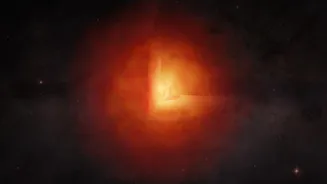
One of JWST's primary goals is to observe the early universe and identify the formation of supermassive black holes. These colossal structures, found at the centers of galaxies, are millions or even billions of times more massive than our sun. JWST's unique capabilities, especially its ability to see through dust clouds, allows it to detect the faint light emitted from these early black holes. Astronomers use JWST to observe distant galaxies and look for the characteristic signatures of black hole activity: actively feeding on surrounding matter. The telescope's infrared sensitivity allows scientists to study the regions where these black holes are forming, providing critical data on the environment and processes that contributed to their rapid growth in the early universe, helping them identify the early black holes.
Analyzing the Data
JWST’s observations provide a wealth of data that astronomers analyze using sophisticated techniques. The light collected by the telescope is broken down into its component wavelengths. By analyzing the light, astronomers can determine the composition, temperature, and motion of the gas and dust surrounding black holes. By studying the light's spectra, scientists can measure the amount of energy emitted by the black hole, which is directly related to its mass and the rate at which it is growing. JWST’s data is also compared with theoretical models and simulations of black hole formation, refining our understanding of how these structures came to be. This enables scientists to create detailed maps and models of these black holes, which helps them understand the details of their formation.
Challenges and Insights
Observing supermassive black holes presents several challenges. These objects are incredibly distant and faint, requiring advanced technology to detect. Furthermore, cosmic dust can obscure the light from these early structures, necessitating the use of infrared telescopes. Despite these challenges, JWST has provided groundbreaking insights into the formation of supermassive black holes. The data gathered suggests that these objects formed rapidly in the early universe, possibly through different mechanisms than previously understood. JWST's observations have also revealed that black holes played a significant role in the evolution of galaxies, influencing the rate of star formation and the overall structure of galaxies in the early cosmos. These discoveries are reshaping our knowledge of how black holes came to be, and these black holes may have played a key role in galaxy formation.
Future Discoveries
The JWST is still in its early years of operation, and its potential for future discoveries is vast. As the telescope continues to observe the universe, astronomers anticipate even more revelations regarding supermassive black holes. Future studies will focus on observing a larger sample of black holes at different stages of their growth. Scientists will also explore the interaction between black holes and their host galaxies in greater detail. JWST's ongoing work will continue to provide insights, leading to a more comprehensive understanding of these cosmic giants, their origins, and their impact on the evolution of the universe. This will also allow further exploration of the complex interplay between black holes and the formation of galaxies in the early cosmos.