Earthquake Sensors Catch Space Debris
When fragments of defunct spacecraft plummet through Earth's atmosphere, they create powerful shock waves. Geophysicists have ingeniously harnessed the widespread
network of earthquake sensors to detect and monitor these atmospheric disturbances. This technique was notably applied to track the re-entry of China's Shenzhou-15 module in April 2024. The method offers a valuable means to follow potentially hazardous debris in near real-time as it approaches the planet's surface. As more spacecraft reach the end of their operational lives and re-enter the atmosphere daily, understanding the fate of their fragments becomes increasingly important. The challenge lies in determining whether these pieces completely disintegrate high above or if some reach the ground, posing a risk to life and property. This seismic approach provides a new capability to answer these critical questions.
Leveraging Seismic Data
As the Shenzhou-15 module broke apart during its atmospheric re-entry, it generated sonic booms traveling at supersonic speeds, between Mach 25 and 30, over areas like Santa Barbara, California, and Las Vegas, Nevada. These intense sound waves produced vibrations strong enough to be registered by a dense network of 125 seismic stations spread across Nevada and Southern California. Researchers utilized readily available data from these stations, meticulously measuring the arrival times of the most significant sonic boom signals. This analysis enabled the creation of a detailed contour map illustrating the debris's flight path and direction of propagation. Furthermore, by comparing the speed of sound to the apparent speed of the shockwave front as it passed the seismic monitors, they were able to estimate the module's altitude during its supersonic descent. Employing a sophisticated seismic inversion model, they then projected potential landing zones for the module's remnants and calculated their ground speeds.
Precision Tracking Benefits
To achieve rapid trajectory estimates within minutes, the researchers streamlined their calculations by temporarily disregarding atmospheric complexities like wind and temperature variations in the lower troposphere. This simplification also eliminated the need for intricate simulations of wave signal propagation through the atmosphere, a requirement for older methods relying on radar data for tracking decaying objects in low Earth orbit. Previous techniques, according to the research team, could result in landing site predictions that were inaccurate by thousands of kilometers in some instances. The ability to track debris accurately and in near real-time is especially beneficial when dealing with potentially dangerous materials. A historical example cited is the 1996 incident involving debris from the Russian Mars 96 spacecraft. Initially believed to have burned up with its radioactive power source landing safely in the ocean, its exact location remained unconfirmed. Later, traces of plutonium were found in a Chilean glacier, suggesting the power source had ruptured during descent and contaminated the area. While radioactive debris is rare, the need for additional tracking tools is evident.
Towards Automated Algorithms
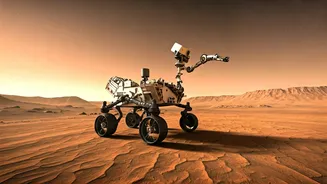
Building on prior work tracking natural celestial objects like meteoroids and asteroids on Earth and Mars using seismometers (including data from NASA's InSight mission on Mars), the team recognized the potential for applying these techniques to terrestrial space debris. The sonic booms from meteoroids breaking up and their occasional ground impacts on Mars proved to be excellent seismic sources, demonstrating the feasibility of this method. This successful application to planetary science inspired its adaptation to the pressing issue of space debris on Earth. The long-term vision involves developing an automated algorithm to reconstruct object trajectories. Currently, identifying sonic booms and analyzing seismic data is a manual and time-consuming process. The researchers aim to secure funding for a follow-up study focused on creating a machine learning tool capable of automatically detecting sonic booms during expected re-entry events and using this data for trajectory reconstruction. They also ponder the crucial question of data dissemination and international frameworks for managing space debris events, noting that established protocols for natural disasters or plane crashes are not yet mirrored for space debris.