
'%3e%3cpath%20fill-rule='evenodd'%20clip-rule='evenodd'%20d='M6%200C10.4183%200%2014%203.58171%2014%207.99999V14.0003C14%2018.4186%2017.5817%2022.0003%2022%2022.0003H122C126.418%2022.0003%20130%2018.4186%20130%2014.0003V8C130%203.58172%20133.582%200%20138%200H6Z'%20fill='%23EDF2E7'/%3e%3c/g%3e%3cdefs%3e%3cfilter%20id='filter0_d_12223_4749'%20x='0'%20y='0'%20width='144'%20height='36'%20filterUnits='userSpaceOnUse'%20color-interpolation-filters='sRGB'%3e%3cfeFlood%20flood-opacity='0'%20result='BackgroundImageFix'/%3e%3cfeColorMatrix%20in='SourceAlpha'%20type='matrix'%20values='0%200%200%200%200%200%200%200%200%200%200%200%200%200%200%200%200%200%20127%200'%20result='hardAlpha'/%3e%3cfeOffset%20dy='8'/%3e%3cfeGaussianBlur%20stdDeviation='3'/%3e%3cfeComposite%20in2='hardAlpha'%20operator='out'/%3e%3cfeColorMatrix%20type='matrix'%20values='0%200%200%200%200.356863%200%200%200%200%200.427451%200%200%200%200%200.270588%200%200%200%200.7%200'/%3e%3cfeBlend%20mode='normal'%20in2='BackgroundImageFix'%20result='effect1_dropShadow_12223_4749'/%3e%3cfeBlend%20mode='normal'%20in='SourceGraphic'%20in2='effect1_dropShadow_12223_4749'%20result='shape'/%3e%3c/filter%3e%3c/defs%3e%3c/svg%3e)
The Generosity Puzzle
Human societies thrive on cooperation, a trait often nurtured from childhood with lessons in sharing and empathy. Yet, individuals exhibit a wide spectrum
of altruism throughout adulthood, with some consistently prioritizing others' well-being over their own, while others tend to focus inwardly. The precise reasons behind these variations in generosity remain an active area of scientific inquiry. Understanding the biological mechanisms that influence our willingness to act selflessly is crucial for grasping the complexities of social interaction and the foundational elements that support collaborative communities. This exploration delves into how manipulating specific neural pathways might sway these deeply ingrained behavioral tendencies.
Testing Altruism in the Lab
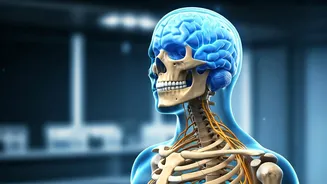
To pinpoint the brain's role in selfless behavior, researchers enlisted 44 volunteers for a series of decisions within a controlled environment known as the Dictator Game. In this setup, participants were presented with opportunities to divide a sum of money with an anonymous partner, deciding on the split for each of 540 distinct scenarios. The amounts varied, sometimes leading to the participant receiving more, and other times less, than their counterpart. Crucially, during these decision-making moments, the scientific team employed a non-invasive technique called transcranial alternating current stimulation. This method directed electrical currents to the frontal and parietal lobes of the brain, aiming to encourage neural cells in these areas to fire in unison, following specific rhythmic patterns, either gamma or alpha oscillations.
Synchrony Fuels Generosity
The findings from this carefully designed experiment were quite remarkable. When the applied brain stimulation specifically enhanced the synchronized activity, or gamma oscillations, between the frontal and parietal regions, participants demonstrated a subtle but significant increase in their altruistic tendencies. This meant they were more inclined to offer a larger portion of the money to their partner, even in situations where keeping more for themselves would have been the more self-beneficial choice. Further analysis using a computational model revealed that this intervention appeared to alter how individuals weighed their options. Post-stimulation, participants seemed to give more consideration to their partner's financial outcome when making their distribution decisions, indicating a shift in their decision-making calculus towards greater fairness and empathy.
Insights from Researchers
The lead researchers emphasized the significance of their findings, highlighting a newly identified pattern of communication between specific brain regions that correlates with altruistic actions. This discovery not only deepens our fundamental understanding of the neural architecture supporting social decision-making but also paves the way for future investigations into human cooperation, particularly in scenarios demanding collective effort. The novelty of this study lies in establishing a cause-and-effect relationship; by precisely altering communication within a targeted neural network through non-invasive stimulation, researchers observed a consistent shift in participants' sharing behaviors, demonstrating a rebalancing of personal interests against those of others. The researchers expressed particular surprise at how a simple boost in coordination between two distinct brain areas could lead to demonstrably more generous choices, even when personal sacrifice was involved.