
'%3e%3cpath%20fill-rule='evenodd'%20clip-rule='evenodd'%20d='M6%200C10.4183%200%2014%203.58171%2014%207.99999V14.0003C14%2018.4186%2017.5817%2022.0003%2022%2022.0003H122C126.418%2022.0003%20130%2018.4186%20130%2014.0003V8C130%203.58172%20133.582%200%20138%200H6Z'%20fill='%23EDF2E7'/%3e%3c/g%3e%3cdefs%3e%3cfilter%20id='filter0_d_12223_4749'%20x='0'%20y='0'%20width='144'%20height='36'%20filterUnits='userSpaceOnUse'%20color-interpolation-filters='sRGB'%3e%3cfeFlood%20flood-opacity='0'%20result='BackgroundImageFix'/%3e%3cfeColorMatrix%20in='SourceAlpha'%20type='matrix'%20values='0%200%200%200%200%200%200%200%200%200%200%200%200%200%200%200%200%200%20127%200'%20result='hardAlpha'/%3e%3cfeOffset%20dy='8'/%3e%3cfeGaussianBlur%20stdDeviation='3'/%3e%3cfeComposite%20in2='hardAlpha'%20operator='out'/%3e%3cfeColorMatrix%20type='matrix'%20values='0%200%200%200%200.356863%200%200%200%200%200.427451%200%200%200%200%200.270588%200%200%200%200.7%200'/%3e%3cfeBlend%20mode='normal'%20in2='BackgroundImageFix'%20result='effect1_dropShadow_12223_4749'/%3e%3cfeBlend%20mode='normal'%20in='SourceGraphic'%20in2='effect1_dropShadow_12223_4749'%20result='shape'/%3e%3c/filter%3e%3c/defs%3e%3c/svg%3e)
The 'Mirror' Amino Acid
Researchers from the Universities of Geneva and Marburg have identified a remarkable strategy in the fight against cancer, focusing on a less common version
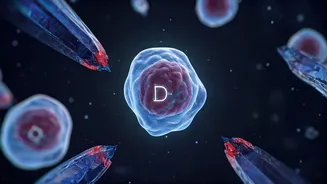
of the amino acid cysteine known as D-cysteine. Amino acids are the fundamental building blocks of proteins, and they typically come in two mirror-image forms: L and D. While our bodies predominantly utilize the L forms for protein construction, the D forms generally play a minimal role in normal biological processes. This peculiar characteristic of D-cysteine is precisely what makes it an attractive candidate for cancer therapy. The key insight is that certain cancer cells have a unique cellular machinery, specifically a particular transporter on their surface, that avidly takes up D-cysteine. Healthy cells, lacking this specialized transporter, are largely indifferent to its presence. This differential uptake is the critical factor enabling D-cysteine to act as a highly selective weapon, targeting cancerous tissues while sparing healthy ones, thereby potentially minimizing the debilitating side effects often associated with conventional cancer treatments.
Selective Cancer Cell Starvation
Once inside susceptible cancer cells, D-cysteine embarks on a mission to disrupt vital cellular functions. The research points to a specific mechanism: D-cysteine inhibits a crucial enzyme called NFS1, which is located within the mitochondria, the powerhouses of the cell. NFS1 is indispensable for the creation of iron-sulfur clusters, essential components for a variety of cellular operations, including cellular respiration (energy production), DNA and RNA synthesis, and the maintenance of genetic stability. By effectively disabling NFS1, D-cysteine triggers a cascade of detrimental effects within the cancer cell. Cellular respiration falters, leading to an energy deficit. DNA becomes vulnerable to damage, and the machinery responsible for cell division halts, effectively stopping the cancer's uncontrolled proliferation. This targeted disruption of core cellular processes underscores the elegance of using a molecule that exploits a specific vulnerability present only in certain types of cancer cells.
Promising Pre-Clinical Results
To test the therapeutic viability of D-cysteine, the research team conducted experiments with mice afflicted with aggressive and difficult-to-treat mammary tumors. The results were highly encouraging, demonstrating a significant reduction in tumor growth when D-cysteine was administered. Critically, the animals treated with D-cysteine did not exhibit major adverse effects, underscoring the compound's selectivity and its potential for a favorable safety profile. These findings suggest that exploiting the unique transporter on certain cancer cells to deliver D-cysteine could indeed be a viable strategy for cancer therapy. The success in animal models provides a strong foundation for further investigation into whether this approach can be translated into a safe and effective treatment for human cancers that overexpress the specific D-cysteine transporter. The potential applications could extend beyond direct tumor treatment to possibly hindering metastasis, a critical and often fatal aspect of cancer progression.