
'%3e%3cpath%20fill-rule='evenodd'%20clip-rule='evenodd'%20d='M6%200C10.4183%200%2014%203.58171%2014%207.99999V14.0003C14%2018.4186%2017.5817%2022.0003%2022%2022.0003H122C126.418%2022.0003%20130%2018.4186%20130%2014.0003V8C130%203.58172%20133.582%200%20138%200H6Z'%20fill='%23EDF2E7'/%3e%3c/g%3e%3cdefs%3e%3cfilter%20id='filter0_d_12223_4749'%20x='0'%20y='0'%20width='144'%20height='36'%20filterUnits='userSpaceOnUse'%20color-interpolation-filters='sRGB'%3e%3cfeFlood%20flood-opacity='0'%20result='BackgroundImageFix'/%3e%3cfeColorMatrix%20in='SourceAlpha'%20type='matrix'%20values='0%200%200%200%200%200%200%200%200%200%200%200%200%200%200%200%200%200%20127%200'%20result='hardAlpha'/%3e%3cfeOffset%20dy='8'/%3e%3cfeGaussianBlur%20stdDeviation='3'/%3e%3cfeComposite%20in2='hardAlpha'%20operator='out'/%3e%3cfeColorMatrix%20type='matrix'%20values='0%200%200%200%200.356863%200%200%200%200%200.427451%200%200%200%200%200.270588%200%200%200%200.7%200'/%3e%3cfeBlend%20mode='normal'%20in2='BackgroundImageFix'%20result='effect1_dropShadow_12223_4749'/%3e%3cfeBlend%20mode='normal'%20in='SourceGraphic'%20in2='effect1_dropShadow_12223_4749'%20result='shape'/%3e%3c/filter%3e%3c/defs%3e%3c/svg%3e)
The Pneumonia Threat
Drug-resistant pneumonia poses a significant challenge in intensive care units, where effective treatment options are increasingly scarce. A particularly
troublesome culprit is Pseudomonas aeruginosa, a bacterium responsible for approximately one in five hospital-acquired pneumonias and notorious for its resistance to multiple antibiotics. This escalating crisis necessitates the exploration of novel therapeutic strategies to combat these tenacious infections and improve patient outcomes in critical care settings.
Nitric Oxide's Dual Role
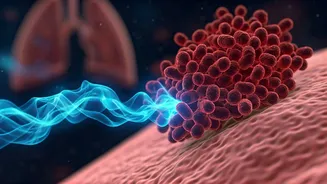
Nitric oxide (NO) is a molecule naturally present in the human body and also utilized medically at low concentrations, typically between 20-80 ppm, primarily to relax blood vessels in the lungs, aiding patients with acute respiratory distress. However, previous research hinted at antimicrobial properties at much higher doses. A study published in Science Translational Medicine investigated this, finding that a concentrated dose of 300 ppm of inhaled nitric oxide significantly reduced drug-resistant Pseudomonas in a large-animal intensive care unit model. This suggests a potential for NO to act as an antimicrobial agent, not just a vasodilator, when administered at supra-physiological levels.
Animal Study Insights
To evaluate the efficacy of high-dose inhaled nitric oxide in a controlled environment mimicking a human ICU, researchers conducted an experiment with 16 ventilated pigs suffering from pneumonia caused by multidrug-resistant P. aeruginosa. These animals were administered the bacteria directly into their lungs and received intensive care for three days. Half the group inhaled nitric oxide at 300 ppm in short, repeated bursts, while the other half received only standard supportive care without antibiotics. Crucially, the treated animals exhibited a remarkable 99% reduction in lung bacterial counts compared to the control group. Furthermore, they demonstrated improved oxygenation and enhanced lung function, suggesting the gas could potentially help restore disrupted chemical signaling within the lungs, facilitating better oxygen transfer and possibly reducing the need for vasopressor medications to maintain blood pressure.
Human Safety Trials
Assessing the safety of delivering these high concentrations of nitric oxide was paramount. Researchers conducted a small phase 1 study involving 10 healthy human volunteers who inhaled nitric oxide at 300 ppm for 30 minutes, three times daily over five days. During this period, methemoglobin levels, a key safety indicator that can interfere with oxygen transport, briefly increased but peaked at 4.5%, well within the established 10% safety threshold. Importantly, no serious adverse effects were reported in these participants. The team also tested the feasibility of administering the high-dose gas to two critically ill ICU patients, confirming that it could be delivered without immediate significant complications, though patient outcomes were not reported in this feasibility assessment.
Potential and Challenges
While the findings offer significant promise, experts urge cautious interpretation. Concerns have been raised regarding the long-term durability of the antimicrobial effect, as even a 1% bacterial load can lead to rapid regrowth once treatment ceases. Additionally, potential toxic effects of nitric oxide, such as increased lung stiffness or direct lung injury, warrant further investigation. Beyond the biological questions, significant practical hurdles exist. Most hospitals are not equipped to deliver nitric oxide at such high concentrations, requiring specialized equipment and trained personnel. Standard systems are typically capped at 80 ppm, and higher doses necessitate continuous monitoring to prevent the formation of harmful nitrogen dioxide and excessive methemoglobin accumulation. Thus, while the research marks an important beginning, clinical efficacy trials are essential to confirm benefits and address the technical and operational challenges before this treatment can be widely adopted.