The Chirality Concept
Just as our left and right hands are mirror images that cannot be perfectly aligned, certain electrons in specialized materials exhibit a property called
chirality, meaning they possess an inherent 'handedness.' This chirality is a specific quantum state that dictates how an electron behaves as it moves through a crystal lattice. In the realm of physics, this phenomenon is particularly relevant in materials known as topological semimetals. However, these 'chiral' electrons are often intertwined with their non-chiral counterparts, making their isolation a complex task. Historically, researchers have resorted to employing extremely strong magnetic fields or meticulously altering the material's chemical composition through doping to distinguish these electrons. These methods, while scientifically valuable, present significant practical limitations, hindering their widespread application in everyday technology and making the pursuit of practical chiral electronics a formidable challenge for the scientific community.
A Crystal's Quantum Geometry
The breakthrough by the IIT-Delhi and German team hinges on exploiting the peculiar quantum geometry inherent in a specific material: palladium gallium (PdGa). Within this crystal structure, electrons don't simply travel in straight lines; they behave more like waves. The crystal's lattice imposes a set of constraints, known as the band structure, which dictates the permissible energy and momentum states for these electron waves. Think of this band structure as a unique, twisted 'road' for electrons. Unlike the straightforward, flat roads found in conventional copper wiring, where an applied voltage directly propels electrons forward, the twisted pathways in the PdGa crystal influence electron movement in a more intricate way. Even when an electron is moving in a generally straight direction, the crystal's geometry can cause its path to drift sideways. Crucially, the direction of this drift – whether to the left or right – is determined by the electron's specific chirality.
Device Design and Functionality
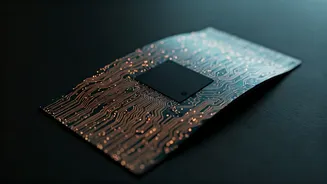
Leveraging this understanding of quantum geometry, the researchers ingeniously designed a compact device featuring a three-armed structure. When an electrical current was introduced into this device, a fascinating phenomenon occurred beyond a certain energy threshold. The unique quantum geometric properties of the PdGa crystal actively 'pushed' the left-handed electrons into one specific arm of the device and the right-handed electrons into another. This sophisticated separation was achieved not by external forces like powerful magnets, but by harnessing the intrinsic characteristics of the material itself. The team emphasized that utilizing quantum geometry as the primary mechanism, rather than relying on external magnetic fields, was a pivotal factor in achieving this 'valve functionality.' This innovative approach allowed them to construct a unique device architecture that effectively demonstrated the ability to control and separate electrical currents based on their opposing electronic chirality, marking a significant advance in the field.
Future Potential and Challenges
While this development represents a substantial leap forward, the path to practical, everyday applications is not without its hurdles. The fabrication of this specialized device currently necessitates the use of ion beams, a technique that adds complexity and cost. Furthermore, the device requires extremely low operating temperatures to function optimally, making it unsuitable for immediate integration into common electronic gadgets. Despite these challenges, the potential implications of this technology are vast and transformative. If these fabrication and operational constraints can be overcome, chiral electronics could usher in an era of ultra-low-power computing, drastically reducing energy consumption. Additionally, this advancement holds promise for the development of entirely new forms of magnetic memory, offering enhanced data storage capabilities and performance.