New Delhi: The Mumbai–Ahmedabad High Speed Rail (MAHSR) project, popularly known as the bullet train project, is steadily taking shape and promises to
AD
significantly cut travel time, improve safety and offer a world-class travel experience for commuters between Mumbai and Ahmedabad. The corridor is expected to reduce end-to-end travel time between Mumbai and Ahmedabad, completing the entire journey in about 2 hours and 7 minutes. The 508-km corridor is being built with technical and financial support from the Government of Japan and is currently the only high-speed rail project under execution in India.
Faster Travel Between Mumbai and Ahmedabad
Once operational, the bullet train will allow passengers to travel between Mumbai and Ahmedabad in just a few hours, compared to the much longer journey times by road or conventional trains. The corridor will pass through Maharashtra, Gujarat and Dadra and Nagar Haveli, with 12 stations planned at Mumbai, Thane, Virar, Boisar, Vapi, Bilimora, Surat, Bharuch, Vadodara, Anand, Ahmedabad and Sabarmati.
The project is designed for high-frequency services and large passenger capacity, making it suitable for daily business travellers, office commuters and tourists.
Safer Stations with Airport-Style Security
For passengers, safety is a major focus. Stations on the corridor will have controlled entry points, baggage scanners, Door Frame Metal Detectors (DFMDs) and round-the-clock CCTV surveillance. Sensitive operational areas will also have high security to ensure passenger safety.
The stations are being designed as city gateways, reflecting local identity while offering modern facilities such as parking areas, drop-off zones and seamless connectivity with other transport modes.
Read More: Mumbai's Coastal Road Becomes India's first 'Musical Road' - Here is How It Works
Comfortable, Smooth and Quieter Rides
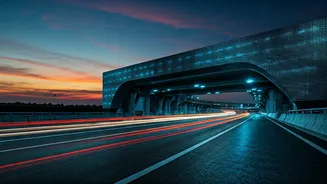
Most of the corridor is being built on elevated viaducts, which helps reduce road crossings and improves safety. Indigenous noise barriers are being installed along the elevated stretches to reduce sound impact on nearby residential areas.
The trains and tracks are being designed with anti-vibration measures and advanced engineering to ensure a smooth and comfortable ride even at very high speeds.
Built for Indian Conditions, Made in India
A major benefit for passengers in the long run is that much of the technology is being developed and manufactured in India. Long-span steel girders, slab tracks, specialised track machines and heavy construction equipment are now being produced domestically.
Indian engineers and skilled workers have been trained in Japanese high-speed rail methods, ensuring that future bullet train corridors can be planned and built faster and more efficiently.
Underground Station and Under-sea Tunnel
One of the most complex parts of the project is the underground section in Mumbai, including the Bandra Kurla Complex (BKC) station. The underground station is being built with a foundation strong enough to support a future 90-metre-high building above it.
The project also includes a 21-km under-sea tunnel, with nearly 4.8 km already completed between Ghansoli and Shilphata in Maharashtra.
How Much Work Has Been Done
All land required for the project, around 1,389.5 hectares, has been acquired, and all statutory clearances have been obtained. Foundation work has been completed at eight stations in Gujarat, while work is progressing at stations in Maharashtra.Seventeen river bridges have already been completed, and work is at an advanced stage on major bridges across the Narmada, Mahi, Tapti and Sabarmati rivers. Depot construction at Thane, Surat and Sabarmati is also underway.
Ticket Prices and Long-Term Benefits
Ticket pricing is expected to be competitive with air and premium rail travel, making the service attractive for frequent travellers. The project has been assessed for long-term viability, factoring in passenger demand, time savings, economic growth and regional development.So far, an expenditure of about Rs 86,939 crore has been incurred on the MAHSR project. The experience gained from this corridor is expected to help India plan more high-speed rail routes in the future.
The government is also strengthening rail infrastructure through Dedicated Freight Corridors, which will free up space on existing railway lines for more passenger trains, indirectly benefiting commuters.
What this Means for Commuters
For Mumbai–Ahmedabad passengers, the bullet train promises faster journeys, high safety standards, modern stations, comfortable travel and reliable services. Once completed, it is expected to change the way people travel between the two cities, making long-distance commuting quicker, smoother and more predictable.