
'%3e%3cpath%20fill-rule='evenodd'%20clip-rule='evenodd'%20d='M6%200C10.4183%200%2014%203.58171%2014%207.99999V14.0003C14%2018.4186%2017.5817%2022.0003%2022%2022.0003H122C126.418%2022.0003%20130%2018.4186%20130%2014.0003V8C130%203.58172%20133.582%200%20138%200H6Z'%20fill='%23EDF2E7'/%3e%3c/g%3e%3cdefs%3e%3cfilter%20id='filter0_d_12223_4749'%20x='0'%20y='0'%20width='144'%20height='36'%20filterUnits='userSpaceOnUse'%20color-interpolation-filters='sRGB'%3e%3cfeFlood%20flood-opacity='0'%20result='BackgroundImageFix'/%3e%3cfeColorMatrix%20in='SourceAlpha'%20type='matrix'%20values='0%200%200%200%200%200%200%200%200%200%200%200%200%200%200%200%200%200%20127%200'%20result='hardAlpha'/%3e%3cfeOffset%20dy='8'/%3e%3cfeGaussianBlur%20stdDeviation='3'/%3e%3cfeComposite%20in2='hardAlpha'%20operator='out'/%3e%3cfeColorMatrix%20type='matrix'%20values='0%200%200%200%200.356863%200%200%200%200%200.427451%200%200%200%200%200.270588%200%200%200%200.7%200'/%3e%3cfeBlend%20mode='normal'%20in2='BackgroundImageFix'%20result='effect1_dropShadow_12223_4749'/%3e%3cfeBlend%20mode='normal'%20in='SourceGraphic'%20in2='effect1_dropShadow_12223_4749'%20result='shape'/%3e%3c/filter%3e%3c/defs%3e%3c/svg%3e)
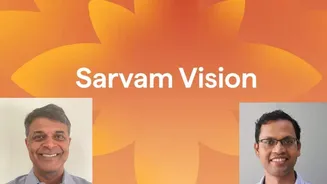
Sarvam AI, founded in 2023, has made waves for its model Sarvam Vision, which recently achieved top scores in OCR, a core technology that allows machines to read and interpret text from images and documents.
By outperforming leading global models, including ChatGPT, Gemini, and Anthropic Claude, Sarvam Vision has established itself as a rising challenger in a field long dominated by Western tech giants.
But, this story is about the brains behind it. If you want to know more about Sarvam AI, here is the in-depth piece.
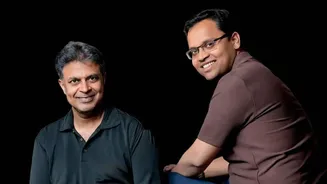
Meet Pratyush Kumar and Vivek Raghavan: Brains behind Sarvam AI
The driving force behind Sarvam AI are two accomplished technologists — Pratyush Kumar and Vivek Raghavan — who share a vision of creating sovereign AI models that are built in India, for India.
Pratyush Kumar, CEO and co-founder of Sarvam AI, is a researcher and engineer with a PhD from ETH Zurich and a Bachelor’s degree from IIT Bombay. Before founding Sarvam AI, he worked with Microsoft Research, IBM Research, and served as an Adjunct Faculty Member at IIT Madras.
Kumar is also known for spearheading initiatives like AI4Bharat, which focuses on Indian-language AI tools, and PadhAI, a platform aimed at providing affordable online learning opportunities. His work has consistently bridged the gap between academic research and real-world applications, especially in the field of language technologies.
His co-founder, Vivek Raghavan, brings over two decades of experience in the field of Electronic Design Automation (EDA). Over his career, Raghavan has founded and successfully sold two EDA firms, in addition to holding senior leadership positions at Magma Design Automation, Synopsys, and Avant! Corporation.
Beyond industry, Raghavan has played a vital role in India’s digital governance ecosystem. He served on the AI Committee of the Supreme Court of India, where he oversaw the rollout of SUVAS (Supreme Court Vidhik Anuvaad Software) — an AI-driven translation tool used to convert court judgments and orders into Indian languages.
He has also contributed to developing AI models for fraud detection in GSTN, advised the National Payments Corporation of India (NPCI), and helped frame the Data Empowerment and Protection Architecture (DEPA), a framework designed to give users greater control over their data.
Together, Kumar and Raghavan represent a rare fusion of deep technical expertise, policy insight, and national vision, all of which underpin Sarvam AI’s mission to create AI systems tailored to India’s linguistic and cultural diversity.
Why is Sarvam AI is taking over the headlines?
Sarvam Vision’s success lies not only in its technical performance but also in what it represents: the possibility of world-class AI innovation from India.
The model has attracted attention for outperforming larger and better-funded global AI systems on the OCR benchmark, a key measure of how effectively an AI model can extract and interpret text from complex images and documents. This is a crucial capability for applications ranging from document scanning and digital archiving to accessibility tools and language translation.
In a recent post on X (formerly Twitter), Pratyush Kumar highlighted how Sarvam Vision excelled across multiple OCR tests, reinforcing its ability to handle diverse, real-world datasets. Experts and industry watchers praised the achievement as a landmark moment for India’s AI ecosystem, proof that local innovation can match, and even beat, global competition.
At Sarvam, we are committed to building India’s full-stack sovereign AI platform - from models grounded in Indian languages and datasets to applications deployed at population scale. We are grateful for these partnerships to provide us the opportunity to create impact at scale.…
— Pratyush Kumar (@pratykumar) February 9, 2026
Sarvam AI’s broader ambition goes beyond one benchmark. The company is building foundational AI models entirely in India, with a focus on Indian languages, accessibility, and local use cases. While global AI players have often struggled to adapt to India’s linguistic diversity, Sarvam aims to make AI truly inclusive and representative.
As global interest in “sovereign AI”, AI developed and owned within national borders, continues to rise, Sarvam AI is positioning itself as a pioneer of this movement. It is noteworthy that this comes after the country announced India Semiconductor Mission 2.0 during the Budget 2026-2027.