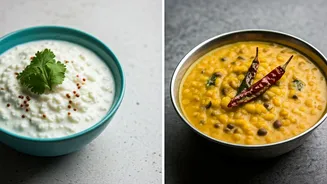
The Power of Homegrown
Embracing homemade curd offers a delightful escape from the preservatives and additives often found in commercial products, contributing positively to
long-term health. Digital creator Shashank Asli recently shared three straightforward methods to consistently produce 'unlimited curd' at home, providing a cost-effective and wholesome alternative. This guide aims to equip you with these techniques, ensuring you can enjoy fresh, thick curd whenever you desire. Making your own dahi not only saves money but also guarantees a purity that is hard to find in pre-packaged varieties. The satisfaction of creating this staple food from scratch, knowing exactly what goes into it, is a significant advantage for health-conscious individuals and families alike.
Method 1: Zesty Lemon
The first technique leverages the natural acidity of lemon juice to initiate the curdling process. By incorporating the juice of half a lemon into a litre of whole milk, you introduce an acidic environment that effectively kickstarts the fermentation. This method is praised for yielding a thick curd with a pleasant, slightly tangy flavour profile, offering a good consistency that’s both appealing and satisfying. The presence of citric acid in lemon juice aids in coagulating the milk proteins, leading to a robust setting. This approach is particularly useful when you want a quick yet effective way to prepare curd, ensuring a delightful outcome without complex steps.
Method 2: Gentle Green Chilli
For the second approach, a whole green chilli is employed to harness the power of naturally occurring lactobacillus bacteria present on its surface. This method utilizes the inherent microbial flora of the chilli to facilitate curd formation. While it sets the curd effectively, the resulting texture is noted to be slightly thinner compared to the lemon-induced curd. Importantly, this method does not impart a strong chilli flavour to the dahi, making it a subtle yet effective way to achieve well-set curd. The bacteria on the chilli act as a natural starter culture, performing the same function as traditional curd starter but in a more unconventional manner.
Method 3: Classic Curd Starter
The most traditional and arguably the most reliable method involves using a small amount of existing, well-set curd as a starter culture. This spoonful of active curd is rich in the necessary live bacteria, ensuring a predictable and consistent fermentation process. This technique is favoured for its ability to produce curd with a perfect texture and a familiar, comforting taste. Because you're introducing an already established culture, the chances of success are significantly higher, making it an excellent choice for beginners or for those who prioritize consistency. It’s the go-to method for replicating the classic homemade dahi experience.
Expert Tips for Thickness
To achieve exceptionally thick curd, experts recommend starting with whole milk for its higher fat content. Simmering the milk for an extended period, about 10 minutes on low heat after boiling, helps to reduce its water content and concentrate the proteins, leading to a firmer set. Frothing the milk by repeatedly pouring it between two vessels is another crucial step; this aeration introduces oxygen and helps in the uniform distribution of the starter culture. Ensure the milk cools to a lukewarm temperature before adding the starter—too hot and it will kill the bacteria, too cold and fermentation will be sluggish. For setting, use a thick-bottomed bowl, a casserole, or an earthen pot, placed in a warm environment for 5 to 8 hours or overnight, depending on ambient temperature. Refrigeration immediately after setting prevents further souring and firms up the curd.
Do's and Don'ts
When making curd, always opt for fresh, high-quality whole milk for the thickest results. Simmering the milk diligently is key, but be careful not to scorch it. The starter curd culture should be at room temperature and of good quality—avoid using sour or old starter, as this will negatively impact the final product. Whisk the starter culture thoroughly into the lukewarm milk to ensure it's uniformly distributed; this is vital for even fermentation. Earthen vessels are highly recommended for their porous nature, which aids in the setting process. If you live in a cooler climate, place the setting curd in an oven with the light on, or wrap it in warm blankets to maintain the required temperature. Remember that milk quality can influence consistency, so be patient, and don't be discouraged if your first attempt isn't perfect; practice makes perfect.