Lunar & Mercury Meeting
As February unfolds, stargazers can witness the delicate dance between the Moon and Mercury. On February 18th, a day after the new moon, a slender crescent
Moon will appear in close proximity to Mercury. To catch this ethereal sight, direct your gaze towards the western horizon shortly after sunset, between 6:15 PM and 7:30 PM. While binoculars can enhance the view, it's crucial to wait until the sun has completely dipped below the horizon to avoid any risk of eye damage. This event offers a fleeting glimpse of our solar system's smallest planet alongside its natural satellite, a beautiful spectacle for patient observers.
Mercury's Eastern Elongation
February 19th marks a significant astronomical occasion: Mercury's greatest eastern elongation. This means the planet will reach its farthest apparent separation from the Sun as viewed from Earth, presenting one of the prime opportunities of the year to spot this elusive world. For a window of about an hour, from 6:20 PM to 7:40 PM, Mercury will be visible in the western sky after sunset. Its position away from the Sun's glare makes it more observable during this period. Look for a bright point of light low on the horizon; its visibility will be enhanced by the twilight conditions, offering a rewarding experience for those who take the time to search for it.
Moon Meets Saturn
On the very same evening as Mercury's peak visibility, February 19th, the sky offers another enchanting pairing: the Moon and Saturn. A two-day-old crescent Moon will be in close attendance with the majestic ringed planet. The visual resemblance will be striking, with the thin lunar sliver appearing like a delicate fingernail beside the iconic celestial sphere. This celestial duo will be observable in the west-southwest for approximately two hours after dusk, from 6:30 PM to 8:30 PM. It's a graceful conjunction that highlights the beauty of planetary and lunar movements against the darkening sky, making for a memorable stargazing moment.
Moon Nears Pleiades
As February progresses, the waxing crescent Moon continues its celestial journey, and on the 23rd, it will drift near the famous Pleiades star cluster. This gathering of stars, often called the Seven Sisters, will form a breathtaking spectacle alongside the Moon, visible to the naked eye and with binoculars. For the best viewing experience, look high in the southwest after sunset, from 7:00 PM until around 1:30 AM. The Moon and the star cluster will embark on a slow westward drift across the sky, eventually setting near 2:00 AM. This conjunction offers a stunning visual treat, showcasing the subtle beauty of our solar system's neighbor.
Six-Planet Parade
The latter part of February heralds an exceptionally rare and captivating event: a 'planet parade' featuring a lineup of six planets stretching across the evening sky. This extraordinary alignment will include Venus, Mercury, and Saturn visible towards the west, while Jupiter will rise in the east. For those equipped with binoculars or a telescope, Uranus and Neptune will also be part of this grand procession, situated near the Pleiades. The optimal viewing period is shortly after dusk, between 6:30 PM and 8:00 PM. Witnessing so many planets visible simultaneously is a truly remarkable astronomical phenomenon that offers a unique perspective on our solar system's architecture.
Milky Way Core Emerges
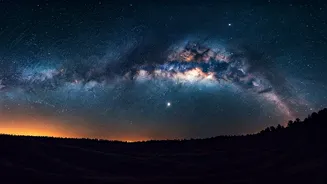
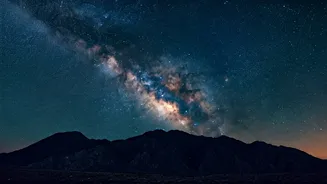
As February draws to a close, the bright, central region of our Milky Way galaxy begins its reappearance in the pre-dawn sky. While this phenomenon is more pronounced from farther southern latitudes, observers in India can catch a glimpse of it. In February, the galactic core will be visible just above the southeastern horizon before sunrise, approximately between 4:30 AM and 5:30 AM. Its visibility is expected to improve progressively through March. For the best experience, seek out dark, clear locations away from light pollution, particularly in the southern parts of the country, to appreciate this subtle yet profound celestial return.