The Water Challenge
Despite receiving abundant rainfall during its monsoon season, Mumbai, like many other Indian metropolises, faces a recurring water shortage each year.
This paradox arises from a combination of factors, including extensive groundwater depletion due to excessive extraction, rapid urban development that replaces permeable surfaces with concrete, and inefficiencies in water management systems. Consequently, millions of liters of rainwater are lost to drains and the sea, while the city often finds itself dependent on water tankers for essential needs. This situation highlights a critical need for localized and sustainable solutions to capture and utilize the available rainwater.
Mukherjee's Innovative Solution
In response to this persistent issue, Subhajit Mukherjee, a Mumbai resident and advocate for environmental action through his organization Mission Green Mumbai, conceptualized an accessible do-it-yourself method for groundwater recharge. Motivated by the environmental impact of groundwater depletion and the squandering of monsoon rains, Mukherjee engineered a straightforward rainwater harvesting system. His approach emphasizes channeling rainwater directly into the ground, thereby replenishing vital underground water reserves instead of allowing this precious resource to flow away unused. This initiative is designed to be adaptable for individuals, residential complexes, educational institutions, and commercial establishments.
The DIY Setup Process
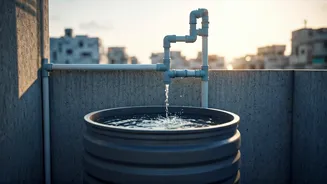
Setting up Mukherjee's rainwater harvesting system is remarkably efficient, achievable in approximately three hours and at a cost ranging from Rs 2,500 to Rs 5,000, making it an economically viable option for most households. The first step involves excavating a pit measuring 4x4 feet, situated 11 to 12 feet away from any building to prevent potential water seepage into foundations. Next, a plastic water tank, drum, or barrel of any suitable size is prepared by drilling multiple small perforations around its body to facilitate water percolation. This prepared container is then positioned within the dug pit. Subsequently, PVC pipes are installed to connect the building's terrace or rooftop to the tank, effectively directing the collected rainwater downwards. The area surrounding the tank within the pit is then filled with pebbles. These pebbles serve a dual purpose: they act as a natural filtration medium, preventing debris from entering the stored water, and create a porous barrier that aids in the slow, steady infiltration of water into the surrounding soil, thereby recharging the groundwater.
Versatile Rainwater Usage
The rainwater collected through Mukherjee's system offers practical benefits beyond groundwater replenishment. It can be utilized for various domestic tasks, such as cleaning floors, washing vehicles, or general household upkeep. This dual utility significantly reduces the dependency on conventionally sourced freshwater for these activities. Mukherjee emphasizes that even a modest saving of five liters of freshwater per household daily can accumulate into a substantial conservation impact over time. For those who do not intend to reuse the harvested water directly, the system still serves its primary function of allowing the water to gradually seep into the ground, contributing to groundwater recharge without requiring active management.
Inspiration and Outreach
Subhajit Mukherjee's initiative was further bolstered by insights gained from interactions with experts at IIT Bombay and a similar rainwater conservation project brought to his attention by Kiran Bedi, the Lieutenant Governor of Puducherry. Inspired by these influences and the effectiveness of his own prototype, Mukherjee has actively used social media platforms to promote and encourage the adoption of rainwater harvesting techniques among schools and other institutions. He generously offers guidance and support to those interested in implementing the system, believing strongly in the collective responsibility of water conservation. Mukherjee acknowledges that the concept of rainwater harvesting is not novel but rather a long-standing practice, and his work is specifically aimed at addressing the immediate concern of groundwater depletion caused by unchecked boring activities.