Naval Might Deployed
In early 2026, the United States significantly amplified its naval presence in West Asia, a strategic move driven by escalating tensions with Iran. The
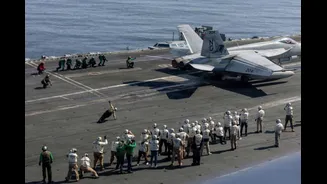
nuclear-powered aircraft carrier USS Abraham Lincoln (CVN-72) was rerouted from the South China Sea to the Arabian Sea, becoming the centerpiece of this enhanced deployment. Onboard, Carrier Air Wing 9 is equipped with advanced F-35C Lightning II stealth fighters and EA-18G Growler electronic warfare aircraft, projecting considerable air power. This formidable carrier is accompanied by a protective screen of guided-missile destroyers: the USS Frank E. Petersen Jr., USS Michael Murphy, and USS Spruance. These destroyers are outfitted with the sophisticated Aegis missile defense system and are capable of launching Tomahawk cruise missiles, providing a multi-layered defense and offensive capability. This naval armada represents a clear signal of intent to safeguard regional interests and deter potential aggression.
Airpower Reinforcements
Complementing the naval buildup, the US Air Force drastically expanded its aerial capabilities across the region. Jordan became a key hub, receiving three squadrons of F-15E Strike Eagles that were relocated from RAF Lakenheath. These potent strike aircraft were joined by F-16 Fighting Falcons and A-10 Thunderbolt IIs, bolstering the Air Force's presence. A particularly significant development was the arrival of additional fifth-generation F-35A stealth jets at RAF Lakenheath on February 9. These advanced aircraft are designated as a 'staging force,' ready to rotate into West Asia to neutralize enemy air defenses if the situation escalates. This infusion of modern air assets across multiple bases highlights a commitment to maintaining air superiority and rapid response capabilities in a volatile geopolitical landscape.
Missile Defense Shield
Addressing concerns over Iran's ballistic missile programs, the Pentagon significantly augmented its missile defense network. Additional Terminal High Altitude Area Defense (THAAD) batteries and Patriot missile systems were strategically deployed to key locations including Jordan, Kuwait, Bahrain, and Saudi Arabia. This deployment is noteworthy, particularly the expansion of THAAD systems, given their limited global inventory. This action underscores the heightened perceived threat to both American personnel stationed in the region and critical energy infrastructure. The robust deployment of these advanced air and missile defense platforms aims to create a formidable shield against potential long-range ballistic missile attacks.
Expansive Base Network
Supporting this extensive military operation is a sprawling network of US bases across West Asia, with over 19 locations and approximately 50,000 troops on high alert as of February 2026. Al Udeid Air Base in Qatar stands as the largest US facility in the Middle East, accommodating over 11,000 personnel and serving as the forward headquarters for CENTCOM, recently enhanced with an integrated air and missile defense coordination cell. Naval Support Activity in Bahrain is the permanent home of the US Navy's Fifth Fleet, coordinating maritime operations in the Persian Gulf and the Strait of Hormuz. Muwaffaq Salti Air Base in Jordan is a critical transit point for the 332nd Air Expeditionary Wing, now hosting the F-15E fighters. Camp Arifjan and Ali Al Salem in Kuwait are vital army installations serving as logistical and staging grounds, particularly near the Iraqi border. Prince Sultan Air Base in Saudi Arabia plays a crucial role in air defense, hosting THAAD and Patriot batteries. Al Dhafra Air Base in the UAE is a major hub for surveillance and reconnaissance, while Incirlik Air Base in Turkey, a strategic NATO site, continues to host US nuclear assets and support aerial refueling missions.