The Ultimate Rehearsal
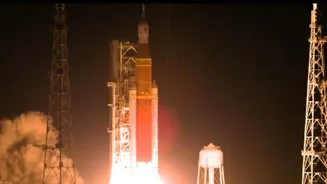
Think of Artemis II as a critical dress rehearsal for humanity's return to the lunar surface. This mission's primary objective is to put the rocket, spacecraft,
and all accompanying systems through their paces in the actual vacuum of space. It’s not about landing on the Moon this time, but about meticulously testing every component and procedure necessary for future crewed landings. A particularly ingenious aspect of the return journey is the reliance on a "free-return trajectory." This clever maneuver harnesses the gravitational pull of the Moon to elegantly swing the spacecraft back towards Earth, negating the need for a powerful rocket burn to initiate the homeward leg. Essentially, space physics takes care of the heavy lifting, demonstrating a sophisticated understanding of orbital mechanics and gravitational assistance. This approach not only saves precious fuel but also represents a significant advancement in mission planning for deep space exploration, ensuring the safety and efficiency of the crewed voyage.
Moments of Silence
During its cosmic voyage, the Artemis II crew will experience brief periods of communication blackout with Earth. These intervals of silence are a natural consequence of the spacecraft's path, particularly when it traverses the far side of the Moon, temporarily obscuring it from direct line-of-sight with our planet. While these communication gaps are expected and accounted for, NASA's robust Deep Space Network is designed to maintain contact for the vast majority of the mission's duration. This network of powerful antennas strategically located across the globe ensures that even with the Moon's formidable presence, the flow of vital information and connection to mission control is largely uninterrupted, a testament to the advanced engineering supporting human spaceflight.
Navigating Radiation
One of the significant challenges facing the Artemis II astronauts is the heightened risk posed by cosmic radiation. Unlike their counterparts on the International Space Station, who benefit from the protective embrace of Earth's magnetosphere, this crew will venture beyond that shield. This increased exposure to energetic particles originating from deep space is a critical area of study. Understanding how the human body reacts to and can potentially withstand these harsh conditions is paramount for future long-duration missions farther afield. The data gathered from Artemis II will be invaluable in developing effective countermeasures and ensuring the long-term health and safety of astronauts venturing into the uncharted territories of our solar system.
A Historic Crew
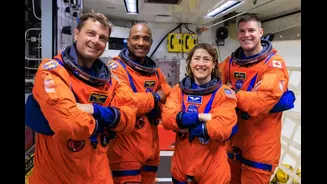
The Artemis II mission is set to make history through its diverse and groundbreaking crew. Victor Glover will etch his name in the annals of space exploration as the first person of color to journey this far from our home planet. Concurrently, Christina Koch is poised to become the first woman to venture beyond low-Earth orbit, marking a significant milestone for female astronauts. Adding to this historic assembly, Jeremy Hansen will be the first Canadian citizen to travel beyond Earth's immediate orbital vicinity. This crew composition represents not just individual achievements but also a broader stride towards inclusivity and global collaboration in humanity's quest to explore the cosmos, reflecting a new era of spacefaring endeavors.
The Space Mascot
Joining the Artemis II crew on their extraordinary journey is a small, plush companion named 'Rise.' This tiny toy serves a charming and practical purpose: it acts as a visual indicator of weightlessness. As the spacecraft leaves Earth's atmosphere and enters the microgravity environment, Rise will begin to float. This floating motion serves as a delightful signal to the astronauts, confirming their transition into zero gravity. This tradition, while lighthearted, underscores the unique physical experiences that define space travel and provides a tangible, albeit whimsical, measure of their departure from terrestrial norms, adding a touch of personality to the mission.
First-Time Jitters
For astronaut Jeremy Hansen, the Artemis II mission represents a monumental first: his inaugural voyage into space. It's a well-documented phenomenon that a significant portion of astronauts, approximately half, experience what is commonly known as 'space sickness' during their initial encounters with microgravity. This condition, often manifesting as nausea and disorientation, is the body's complex response to the absence of familiar gravitational cues. While Hansen is undoubtedly prepared, the possibility of experiencing these first-time jitters is a relatable human element within the highly technical context of space exploration, highlighting the adaptive challenges astronauts face.
Breaking the Record
If all goes according to NASA's meticulously planned trajectory, the Artemis II mission is poised to eclipse a space travel record that has stood for an astounding 50 years. Upon venturing beyond Earth's orbit, the astronauts will journey farther from our planet than any human has since the Apollo 13 mission. This significant distance will exceed 400,000 kilometers, marking a substantial re-engagement with the vastness of deep space after a prolonged hiatus. This feat signifies a crucial step in NASA's ambitious Artemis program, demonstrating renewed capability and intent to push the boundaries of human exploration farther into the cosmos than ever before.
Blazing Re-entry
The return of the Artemis II crew to Earth will be an event of incredible speed and intensity. As the spacecraft plunges back into our planet's atmosphere, it will be traveling at a staggering velocity exceeding 40,000 kilometers per hour. This velocity represents the fastest re-entry speed ever undertaken by a human-crewed spacecraft. The sheer kinetic energy involved necessitates a robust heat shield and precise trajectory control to ensure the safety of the astronauts. This high-speed atmospheric interface is a critical phase of any space mission, showcasing the advanced engineering and rigorous testing required to bring explorers safely home from the depths of space.
Future Focus
The Artemis II mission is fundamentally about more than just a return to deep space; it's a critical stepping stone for future lunar habitation and beyond. This endeavor is laying the groundwork for Artemis III, a subsequent mission with the audacious goal of landing astronauts near the Moon's south pole. The immense scientific interest in this region stems from the potential discovery of water ice. If confirmed and accessible, this water could be a game-changer, transformable into vital resources like drinking water, rocket fuel, and breathable oxygen. The presence of these resources is indispensable for establishing sustainable human outposts on the Moon, paving the way for long-term human presence and further exploration of the solar system.