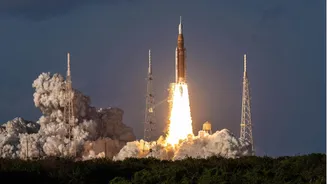
Camera Arsenal Deployed
The Artemis II mission is a visual feast, boasting an impressive collection of at least 28 cameras. These devices are strategically placed both externally
on the spacecraft and within the cabin, serving as the eyes of humanity’s return to lunar orbit. Astronauts also have handheld units to capture intimate moments of the journey. This extensive camera deployment ensures comprehensive documentation, from the raw power of liftoff to the serene, star-filled expanse of deep space, providing unparalleled insights into the mission's progress and the breathtaking vistas encountered along the way. The sheer number and variety of cameras underscore the mission's commitment to thorough visual recording.
Proven and Future Optics
Among the imaging equipment, traditional yet reliable optics play a crucial role. A decade-old DSLR model, known for its robust performance in space environments, has been chosen for its proven ability to withstand the harsh radiation and microgravity conditions of spaceflight, offering engineers a sense of dependable familiarity. Complementing this veteran is a cutting-edge mirrorless camera, making its inaugural flight. This advanced model is earmarked for an even more critical role in subsequent missions, including a potential lunar landing. Significant modifications are planned for its deployment, involving specialized circuit redesigns to combat cosmic radiation, custom software tailored for extravehicular activities on the lunar surface, and ergonomic enhancements to accommodate bulky astronaut gloves. Protective thermal coverings, akin to those used on the International Space Station, will also be integrated, alongside specially adapted lenses designed to endure the extreme temperature fluctuations and radiation prevalent on the Moon.
Rugged Expedition Companions
Adding to the mission's visual documentation capabilities are four highly specialized action cameras. These devices are securely mounted on the solar array wings of the Orion spacecraft, offering an external perspective on the vehicle itself, as well as panoramic views of Earth and the Moon. Beyond their primary recording function, these rugged cameras serve a vital secondary purpose as inspection tools. During crucial mission phases, their feeds allow ground control to visually verify the spacecraft's structural integrity from Earth. This inclusion highlights the manufacturer's long-held belief in the resilience and adaptability of its products, capable of performing under the most demanding circumstances, whether in extreme terrestrial environments or the vacuum of space, over 240,000 miles away.
Personal Devices in Orbit
Breaking new ground, this mission marks a significant milestone as personal smartphones have been officially sanctioned for use by the crew. This authorization means that both operating systems, represented by iPhones and Android devices, have ventured beyond Earth's gravitational pull on a NASA mission for the first time. The astronauts have fully embraced this opportunity, with video footage circulating online showcasing them engaging in zero-gravity activities, including tossing their handsets between each other, demonstrating the novel experience of using personal technology in space.
High-Speed Data Transmission
A truly groundbreaking element of the Artemis II mission is its advanced optical communications system. This technology leverages laser beams to transmit data between the spacecraft and Earth, achieving speeds significantly faster than traditional radio wave methods. This enhanced bandwidth is sufficient to stream high-definition video, including 4K footage, directly from the vicinity of the Moon. In addition to visual data, this system will expedite the transfer of essential mission-critical information, such as flight plans, operational procedures, and photographic data, facilitating seamless communication and rapid decision-making between the crew and mission control.