Pink Moon's Glow
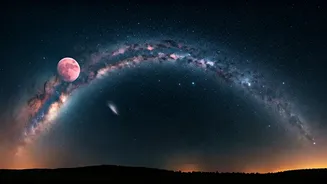
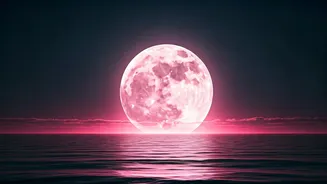
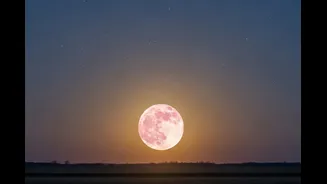
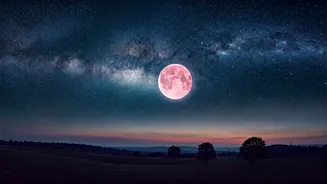
As April begins, the night sky will be graced by the Pink Moon, which is actually the full moon of April. Contrary to its name, this moon won't appear
pink; its name originates from the blooming of a wildflower, moss phlox, native to eastern North America. This natural phenomenon occurs on April 4th, 2026, presenting a beautiful full lunar disk that will be visible throughout the night, provided cloud cover permits. It’s an excellent opportunity for photographers and casual observers alike to capture the moon in its full glory. The illumination from this full moon will temporarily reduce the visibility of fainter celestial objects, but the moon itself is a stunning sight. Observing it from a location with minimal light pollution will enhance its ethereal glow and provide a memorable experience for all sky watchers.
Lyrids Meteor Shower
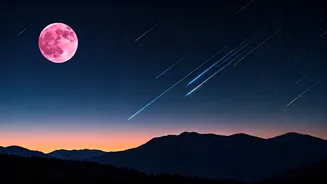
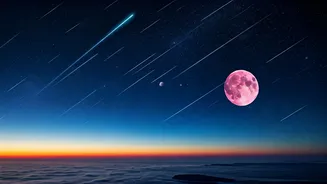
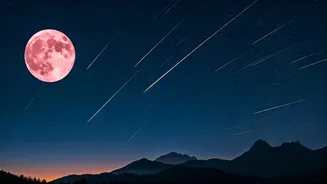
The Lyrids meteor shower, a delightful celestial event, will reach its peak activity in the early hours of April 23rd, 2026. This annual shower is produced by debris left behind by Comet C/1861 G1 (Thatcher). While it's not as intense as some other meteor showers, the Lyrids can produce up to 20 meteors per hour under ideal dark sky conditions. The radiant point for this shower is in the constellation Lyra, hence the name. To best enjoy the Lyrids, find a spot away from city lights, lie back, and allow your eyes to adjust to the darkness for at least 20 minutes. Look towards the northeastern sky after midnight for the best chance to spot these fleeting streaks of light, which can be remarkably bright and leave persistent trails.
Venus Shines Bright
Throughout April 2026, the planet Venus will be a prominent and radiant presence in the evening sky. As the second planet from the Sun, Venus is often referred to as the 'Evening Star' or 'Morning Star' due to its brilliance. In April, it will be visible shortly after sunset, setting a beautiful stage for your stargazing adventures. Its apparent brightness is due to its proximity to Earth and its highly reflective cloud cover. Observing Venus with binoculars or a small telescope can reveal interesting details, such as its phases, which are similar to those of the Moon. Its consistent visibility makes it a reliable and breathtaking sight for anyone looking to enjoy the wonders of our solar system.
Saturn's Ringed Majesty
The planet Saturn, renowned for its magnificent rings, will also be a captivating sight in April 2026. While not at its absolute brightest, Saturn will still be well-positioned for observation throughout the month. It will appear as a steady, yellowish star in the night sky. For those with access to a telescope, the true spectacle of Saturn's rings becomes apparent. Even a modest telescope can reveal the distinct separation between the main rings (the Cassini Division) and the planet's upper atmosphere. Early evening viewing will be ideal as Saturn climbs higher in the sky. Its presence serves as a constant reminder of the diverse and majestic planetary bodies that share our cosmic neighborhood.
Jupiter's Great Red Spot
The gas giant Jupiter, the largest planet in our solar system, will continue to be a highlight for astronomers in April 2026. While it may be setting earlier in the evening by this point in the year, it's still worth seeking out. Jupiter's most famous feature, the Great Red Spot, a persistent anticyclonic storm, can be observed with a telescope of moderate size. In addition to the Great Red Spot, keen observers can also spot the planet's prominent cloud bands, which are a testament to its turbulent atmosphere. The four largest moons of Jupiter – Io, Europa, Ganymede, and Callisto – are also visible as tiny points of light, often seen transiting across the planet's disk or casting shadows.
The Pleiades Cluster
The enchanting Pleiades star cluster, also known as the Seven Sisters, will be a stunning visual treat in April 2026. This open star cluster, located in the constellation Taurus, is easily visible to the naked eye, appearing as a small, fuzzy patch of stars. It contains hundreds of stars, though only a handful are typically visible without optical aid. With binoculars or a small telescope, the true beauty of the Pleiades unfolds, revealing a breathtaking collection of young, hot, blue stars embedded in a faint, wispy nebula. It's a quintessential celestial jewel, perfect for adding a touch of wonder to your April skywatching. Its ethereal glow and dense concentration of stars make it a universally recognized and admired astronomical landmark.
Andromeda Galaxy View
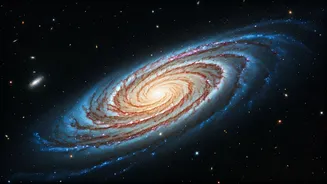
For those with a keen interest in deep-sky objects, April 2026 offers a chance to glimpse the Andromeda Galaxy (M31). As the closest spiral galaxy to our own Milky Way, Andromeda is a truly awe-inspiring sight, located approximately 2.5 million light-years away. Under very dark, moonless skies, it can be seen as a faint, elongated smudge with the naked eye. However, to truly appreciate its grandeur, a telescope is recommended. Even a small telescope will reveal a brighter central core and hint at its spiral structure. It’s a humbling reminder of the vastness of the universe and the incredible distances involved in astronomical observation. Spotting Andromeda is a rewarding experience for any aspiring astronomer.
Orion's Belt Recedes
As April progresses into spring, the prominent constellation Orion, easily recognizable by its distinct belt of three stars, will begin its seasonal descent towards the western horizon. While it won't be as dominant as in the winter months, it remains a significant and familiar celestial landmark. Observing Orion in April provides an opportunity to appreciate its key features one last time before it largely disappears from the evening sky for the summer. Its hunter-like shape, the bright red giant Betelgeuse at one shoulder, and the blue supergiant Rigel at the opposite foot are all worth noting. This diminishing presence marks the changing seasons in the night sky, a subtle yet consistent rhythm of the cosmos.