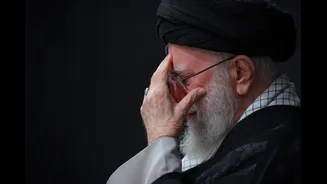
Summit Focus: Iran's Missiles
Prime Minister Benjamin Netanyahu's upcoming rendezvous with US President Donald Trump in Washington is primarily centered on Iran's advancing ballistic
missile technology. This critical discussion takes place against the backdrop of ongoing international negotiations concerning Iran's nuclear program. Netanyahu has explicitly stated that the core objective of his talks with Trump will be to address the specifics of Tehran's missile development, a program that has become a significant security concern for Israel. While the United States has indicated a desire to broaden the scope of these negotiations to encompass both Iran's nuclear ambitions and its missile capabilities, Iran has thus far shown reluctance to expand the dialogue beyond its nuclear activities. This meeting marks Netanyahu's sixth visit to the US since Trump assumed office, highlighting the continuous diplomatic engagement between the two nations on regional security matters. Their last encounter in Jerusalem in October 2025, which coincided with Trump's announcement of a Gaza ceasefire, is recalled as a significant diplomatic moment. The current meeting follows recent diplomatic exchanges between the US and Iran held in Oman, underscoring the active diplomatic maneuvering in the region.
Regional Tensions & West Bank Concerns
This significant diplomatic engagement between Israel and the United States unfolds against a backdrop of international scrutiny concerning Israel's policies in the West Bank, notably the facilitation of land purchases directly from Palestinian owners by settlers. It remains uncertain whether this contentious issue will be brought up for discussion between President Trump and Prime Minister Netanyahu, despite Trump's historical opposition to Israeli annexation plans in the region. Israel unequivocally perceives Iran's missile capabilities as a formidable threat, capable of delivering swift strikes that could potentially overwhelm existing air-defense systems. The memory of the June 2025 conflict, during which waves of Iranian missiles inflicted substantial damage on both military and civilian infrastructure within Israel, serves as a stark reminder of this vulnerability. Security experts emphasize that while these missile threats may not be existential in nature, they constitute a serious and immediate security challenge for Israel. Analysts also observe that Prime Minister Netanyahu appears concerned about President Trump's potential hesitance to consider a military response against Iran. Consequently, Netanyahu's strategic aim is to secure explicit US recognition of Israel's defined 'red line' concerning Iran's missile arsenal, ensuring that this critical aspect is integrated into any forthcoming nuclear agreement with Tehran.
Escalating Confrontation & Diplomatic Stance
Recent escalations in tensions between Israel and Iran, stemming from Israeli strikes on Iranian military and nuclear installations in June 2025, have amplified the urgency of the missile threat. These subsequent Iranian missile attacks, coupled with earlier drone strikes originating from Iran, have intensified Israel's imperative to highlight missile concerns as a paramount issue alongside its nuclear anxieties. In response to Netanyahu's impending visit, Iran's foreign ministry issued a stern warning, suggesting that the trip could have a 'destructive' effect on diplomatic efforts and regional stability. Israeli officials, in the lead-up to this high-stakes meeting, have consistently advocated for robust measures to effectively mitigate the missile threat posed by Iran. This visit underscores the profound importance of US-Israel diplomatic relations, as it seeks to navigate the complex interplay between ongoing negotiations with Iran, broader regional security considerations, and persistent concerns related to Gaza and the West Bank.