
'%3e%3cpath%20fill-rule='evenodd'%20clip-rule='evenodd'%20d='M6%200C10.4183%200%2014%203.58171%2014%207.99999V14.0003C14%2018.4186%2017.5817%2022.0003%2022%2022.0003H122C126.418%2022.0003%20130%2018.4186%20130%2014.0003V8C130%203.58172%20133.582%200%20138%200H6Z'%20fill='%23EDF2E7'/%3e%3c/g%3e%3cdefs%3e%3cfilter%20id='filter0_d_12223_4749'%20x='0'%20y='0'%20width='144'%20height='36'%20filterUnits='userSpaceOnUse'%20color-interpolation-filters='sRGB'%3e%3cfeFlood%20flood-opacity='0'%20result='BackgroundImageFix'/%3e%3cfeColorMatrix%20in='SourceAlpha'%20type='matrix'%20values='0%200%200%200%200%200%200%200%200%200%200%200%200%200%200%200%200%200%20127%200'%20result='hardAlpha'/%3e%3cfeOffset%20dy='8'/%3e%3cfeGaussianBlur%20stdDeviation='3'/%3e%3cfeComposite%20in2='hardAlpha'%20operator='out'/%3e%3cfeColorMatrix%20type='matrix'%20values='0%200%200%200%200.356863%200%200%200%200%200.427451%200%200%200%200%200.270588%200%200%200%200.7%200'/%3e%3cfeBlend%20mode='normal'%20in2='BackgroundImageFix'%20result='effect1_dropShadow_12223_4749'/%3e%3cfeBlend%20mode='normal'%20in='SourceGraphic'%20in2='effect1_dropShadow_12223_4749'%20result='shape'/%3e%3c/filter%3e%3c/defs%3e%3c/svg%3e)
A New Era Dawns
Ferrari has offered a compelling glimpse into the cockpit of its highly anticipated all-electric supercar, christened the 'Luce,' a name that beautifully
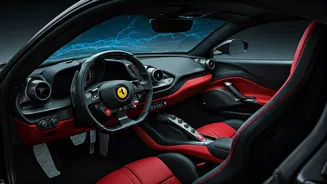
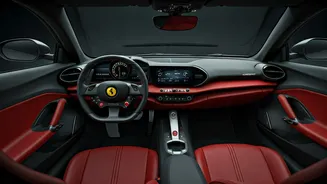
translates to 'light' in Italian. This reveal is particularly noteworthy as the interior design has been meticulously shaped by the renowned Jony Ive, formerly of Apple. This marks a significant evolution for the legendary marque, venturing into the electric vehicle segment with a strong emphasis on design philosophy. The Luce's interior showcases a harmonious fusion of Ferrari's rich racing legacy and Ive's signature minimalist approach. While the exterior remains under wraps, the interior's debut, spearheaded by Ive's design studio LoveFrom, has already ignited considerable interest, hinting at a potential direction for future Apple-designed vehicles. This collaboration, quietly nurtured over five years, represents the first public fruit of the partnership between Ferrari and LoveFrom, promising a unique driving experience.
Ive's Design Imprint
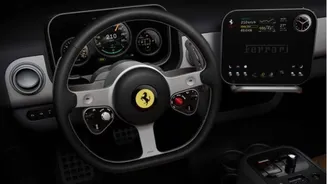
The influence of Jony Ive's design ethos is immediately apparent in the Ferrari Luce's interior, particularly in its sophisticated approach to controls and interface. The steering wheel, crafted from recycled aluminum and boasting a light, three-spoke configuration, draws inspiration from the elegant designs of Ferraris from the mid-20th century. Integrated into the wheel are two distinct pods housing an array of physical buttons for essential functions such as turn indicators, wipers, and cruise control, alongside a specific setting for bumpy roads. Crucially, it retains the iconic red Manettino switch, a hallmark of Ferrari performance. For powertrain selection, a finely knurled rotary dial offers intuitive access to modes like 'Range,' 'Tour,' and 'Performance,' enabling drivers to tailor the car's behavior to their needs. This thoughtful arrangement eschews complexity for clarity, a testament to Ive's design principles.
Integrated Technology
Beyond its aesthetic appeal, the Luce's interior is a masterclass in integrating modern technology seamlessly. A 10-inch touchscreen, reminiscent of contemporary tablets, is a central feature, allowing for dynamic control and access to various functions. This display can be intuitively adjusted via a palm rest platform, enhancing user interaction. Below the main screen, a series of toggle switches manage secondary controls like media playback and climate settings. A versatile clock display offers both analog and digital formats and can even function as a compass or a lap timer, adding a layer of practical utility. The digital instrument cluster, spanning 12.5 inches, cleverly mimics the appearance of three traditional analog dials within a black housing. This illusion is achieved through sophisticated OLED technology, utilizing custom Samsung panels to create a convincing three-dial layout. The central dial prominently displays vehicle speed, while the outer dials dynamically adapt based on the selected powertrain mode. This advanced display also provides vital alerts, navigation prompts, and gear-shifting guidance.
Futuristic Console & Ignition
The center console of the Ferrari Luce is a striking architectural element, crafted from a premium combination of leather and glass. It houses a glass- selector knob for choosing the drive gears, adding a touch of refined tactility. A particularly captivating feature is the integrated recess for the ignition key. Upon insertion, the key undergoes a visual transformation, shifting from yellow to black, symbolically indicating the transfer of power and the awakening of the vehicle's systems. For activating launch control, a specialized, helicopter-style grip is positioned overhead, accompanied by switches for exterior lighting. The console also offers practical storage solutions, including two cubbies and two cup holders, alongside buttons for central locking and all window controls. Rear-view screens are strategically placed to provide drivers with essential data such as speed, lap times, and telemetry, further enhancing the performance-oriented environment.