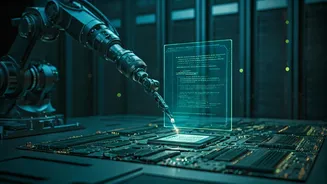
The AI Code Takeover
The landscape of software development is undergoing a seismic shift, with artificial intelligence rapidly advancing to handle core coding responsibilities.
Major technology firms are already leveraging AI to assist in the creation of new codebases, a practice anticipated to become even more prevalent. This development has prompted a stark warning from Dario Amodei, the chief executive of Anthropic, who posits that the profession of software engineering could effectively cease to exist in its current form within the next year. While this assertion has ignited considerable discussion, it has also found resonance among prominent figures in the tech industry. Notably, Sridhar Vembu, the founder of Zoho, has emphasized the gravity of Amodei's warning, suggesting it warrants serious consideration due to the advanced AI coding tools Anthropic is developing.
Shifting From Aid to Executor
Amodei articulated his concerns by explaining that AI is transitioning from merely augmenting human capabilities to becoming the primary agent in executing tasks. Software development is presented as a prime illustration of this evolving dynamic. Within Anthropic itself, engineers are increasingly relying on sophisticated AI models to generate code. Their role is shifting towards reviewing and refining the outputs produced by these AI systems, rather than initiating code from scratch. Amodei shared an anecdote from his own engineering leadership, where leads have reported that they no longer write code themselves, instead allowing AI models like 'Opus' to perform the coding and then editing the results. This highlights a fundamental change in the workflow and the nature of a software engineer's contribution, moving from direct creation to oversight and quality assurance.
Broader Economic Implications
While Amodei's initial warning specifically targeted software developers, he stressed that the repercussions of AI's rapid advancement extend significantly beyond the realm of software engineering teams. He suggested that as AI models become increasingly adept, they could precipitate substantial job displacement across a wide array of industries. Amodei drew a parallel to Moore's Law, describing a similar exponential growth in AI's cognitive capabilities occurring every few months. As these AI systems become more proficient in handling increasingly complex challenges, the demand for large human programming teams may diminish considerably, potentially leading to the obsolescence of job categories that have taken decades to establish and evolve. This forward-looking perspective underscores the widespread economic and societal transformations that AI is poised to bring about.