Orbital Validation First
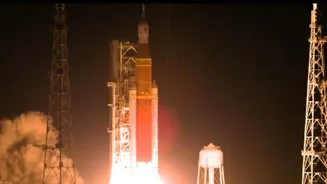
The Artemis II mission, slated for September 2025, is a pivotal, yet non-landing, step in NASA's ambitious plan to return humans to the Moon. Its primary
focus is a comprehensive test of the Orion spacecraft and its sophisticated systems during a journey around lunar orbit. This 10-day expedition, carrying four astronauts including Canada's first lunar traveler, is designed as a full-scale rehearsal. Before attempting a surface touchdown, the mission meticulously validates the capabilities of the Space Launch System (SLS) rocket and the Orion capsule in the harsh realities of deep space. This mirrors historical precedents, such as the Apollo 8 mission, which orbited the Moon before any landing attempts, emphasizing the critical importance of proving human deep-space travel safety before the more complex maneuver of landing.
Apollo's Race vs. Artemis's Endurance
The context for Artemis is vastly different from the Apollo era. Apollo was fueled by the intense Cold War competition, demanding a swift, symbolic victory of landing a human on the Moon before the end of the 1960s. This singular, time-bound goal led to a highly funded and narrowly focused program that concluded shortly after its objective was met. In contrast, Artemis operates without a ticking clock or a singular finish line. NASA's objective is not just a one-time achievement but the establishment of a sustained, long-term human presence on the Moon. This fundamental shift towards sustainability necessitates a more deliberate and phased approach, prioritizing the development of infrastructure and capabilities for ongoing exploration and eventual missions to Mars, rather than a quick return. The speed-driven nature of Apollo is replaced by a focus on endurance and long-term presence.
Crucial Pre-Landing Tests
Artemis II's non-landing status is a calculated safety measure, essential for human spaceflight. The mission will meticulously monitor the spacecraft's life support systems, ensuring critical functions like air purification and carbon dioxide removal operate flawlessly in the deep vacuum of space. Radiation levels, significantly higher beyond Earth's protective magnetosphere, will be rigorously measured. Astronauts will practice manual control and complex maneuvering, skills vital for future docking procedures with lunar landers or orbiting stations. Prior to venturing towards the Moon, Orion will remain in a high Earth orbit 'safe zone,' allowing for system verification and an abort option if any anomalies arise. Once on its lunar trajectory, the mission utilizes a 'free-return' path, an inherent safety feature that guides the spacecraft around the Moon and back to Earth even if critical systems fail. Furthermore, the mission will test the spacecraft's high-speed re-entry, a potentially perilous phase where Orion must withstand extreme temperatures and G-forces. Essentially, Artemis II is designed to prove NASA's capability to safely transport humans to the Moon and return them, a prerequisite for any landing attempt.
Heat Shield Concerns Addressed
A significant challenge emerged during the uncrewed Artemis I mission in 2022 when Orion's heat shield exhibited unexpected cracking during its fiery re-entry. Investigations revealed that heat accumulation patterns during the spacecraft's specific trajectory were the cause. For Artemis II, NASA opted to adjust the re-entry profile rather than undertake a full heat shield replacement. This decision elevates the importance of the crewed mission, making the validation of the spacecraft's performance with astronauts aboard absolutely critical before any attempt to land on the lunar surface. The successful completion of Artemis II under these modified conditions will provide the necessary confidence for future landing endeavors.
Complexity of Modern Landings
Contemporary lunar missions face a far greater level of complexity compared to the Apollo era. Modern standards demand stringent safety protocols, and the ultimate goal is not merely a visit, but the establishment of a lasting human presence. Artemis envisions building the necessary infrastructure, such as the Gateway space station, developing advanced spacesuits, and creating reliable new landing systems. The objective extends beyond simply landing astronauts; it's about ensuring their ability to live and work safely on the Moon over extended periods. This significantly raises the technical and operational bar compared to the short-duration missions of the past, requiring more robust and sustainable systems.
Beyond the 'Lost Tech' Myth
A common misconception suggests that NASA has somehow lost the capability to land on the Moon. This is inaccurate. The reality is that the specific technologies and production lines for Apollo-era systems, like the mighty Saturn V rocket, were retired decades ago. Modern space exploration is built upon entirely new technological foundations and adheres to contemporary standards. This transition is not a diminishment of capability but a necessary evolution towards a new generation of systems designed to meet the distinct, long-term objectives of the Artemis program. The focus is on building future capabilities, not replicating past ones.
Artemis II's Tangible Achievements
While Artemis II will not make a lunar landing, its achievements are profound and foundational. This mission will rigorously validate the critical systems required for human deep-space exploration, proving definitively that humans can safely venture beyond low Earth orbit once again. The crew's journey and the spacecraft's performance will provide invaluable data, building confidence and paving the way for subsequent missions that will include landing. It represents a crucial step in demonstrating the reliability and safety of the Orion spacecraft and the SLS rocket for extended deep-space voyages, which is paramount for the long-term goals of the Artemis program.
Moon as a Stepping Stone
Artemis is intrinsically linked to a broader vision for humanity's future in space. NASA views the Moon not as an ultimate destination, but as a vital stepping stone for more ambitious ventures, including eventual human missions to Mars and beyond. The program's emphasis has shifted from merely reaching the Moon to establishing a sustainable presence that can serve as a base for deeper space exploration. Therefore, Artemis II's decision to orbit rather than land is not an indication of inability, but a deliberate strategic choice within a much larger, more complex, and long-term plan. Apollo demonstrated that humans could reach the Moon; Artemis aims to prove they can establish a lasting presence there, transforming it into a hub for future discovery. This distinction is precisely why Artemis II's trajectory is around the Moon, not down onto its surface.