The Enchanting Pink Moon
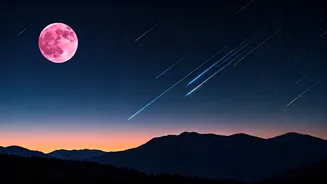
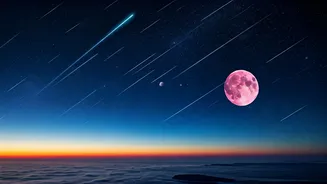
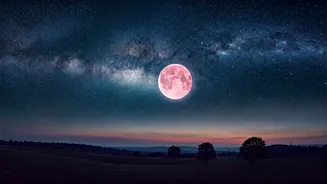
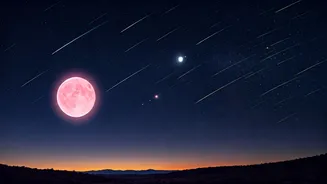
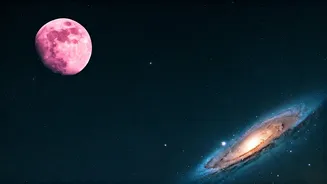
As spring's first full moon graces the night sky on April 2026 at 10:12 PM ET, it will be known as the 'Pink Moon.' This evocative name isn't about its
color but rather the simultaneous blooming of the vibrant moss pink flowers across North America. Adding to its allure, this full moon will occur when our lunar companion is near its closest approach to Earth, presenting a supermoon effect. Observers can anticipate a moon that appears approximately 15% brighter and marginally larger than its typical appearance, creating a truly breathtaking spectacle for all to behold.
Mercury's Morning Ascent
In the early dawn hours of April 2026, Mercury will achieve its most distant point from the Sun, a phenomenon known as greatest eastern elongation. This celestial arrangement significantly enhances its visibility low on the eastern horizon just before sunrise. Typically, Mercury is elusive due to its proximity to the Sun's glare, making it a challenge to observe. However, this orbital alignment offers astronomers an exceptional window to study the planet's surface features and its tenuous atmosphere with greater clarity and detail than usual.
Spectacular Sun-Grazing Comet
A captivating comet is set to embark on a perilous journey, passing extremely close to the Sun – a mere 850,000 miles away. The intense solar heat will cause the comet's icy core to sublimate, transforming into gas and forming a brilliant, glowing atmosphere (coma) and an extended tail. If the comet maintains its structural integrity during this close encounter, it has the potential to evolve into a magnificent 'Great Comet.' Such an event would render it a spectacular sight, readily visible in the morning sky and a highlight for stargazers worldwide.
Planetary Parade Formation
A rare celestial gathering is on the horizon for April 2026, as Mercury, Mars, Saturn, and Neptune will appear in close proximity within the sky. While these planets will visually seem clustered together, it's important to remember their vast actual distances, with millions of miles separating them. These planetary alignments are invaluable for astronomers, providing critical opportunities to further our understanding of the solar system's dynamics and to precisely calibrate observational instruments for future studies.
Moon, Venus, Pleiades Trio
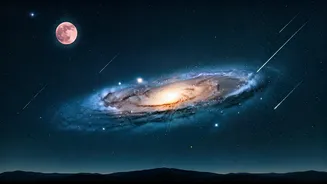
During select nights in April 2026, an exceptionally beautiful celestial tableau will unfold as the Moon, the planet Venus, and the renowned Pleiades star cluster converge into a striking visual proximity. This type of apparent closeness between celestial bodies, known as a conjunction, offers a magnificent spectacle. It's a delightful event for both casual observers who appreciate the aesthetic beauty of the night sky and professional astronomers keen on tracking the intricate movements and alignments of planets and star systems.
The Lyrids Meteor Shower
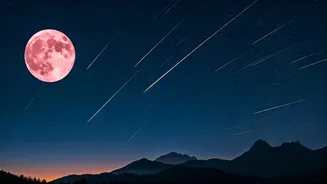
Prepare for the annual Lyrids meteor shower, an event stemming from the cosmic dust trail left behind by Comet Thatcher. As our planet traverses this debris field, minuscule particles enter Earth's atmosphere at incredible speeds of up to 110,000 mph. Their fiery disintegration creates the brilliant streaks of light we recognize as meteors. This meteor shower boasts a rich history, having been documented for over 2,700 years, making it one of the most ancient and consistently observed celestial phenomena known to humankind.
Whirlpool Galaxy Showcase
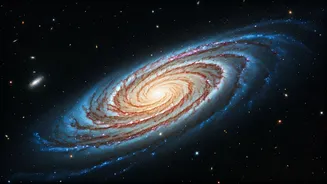
April 2026 presents an optimal period for observing the majestic Whirlpool Galaxy, also cataloged as Messier 51. Located approximately 31 million light-years from Earth, this magnificent spiral galaxy is currently engaged in a gravitational dance with its smaller companion, NGC 5195. This dynamic galactic pairing offers astronomers an unparalleled opportunity to investigate the complex processes of star formation occurring within the spiral arms of galaxies.
Aurora Season's Farewell
As the Northern Hemisphere welcomes longer daylight hours in April, the increasing brightness of the sky will unfortunately obscure the visibility of the Northern Lights. Despite continued solar activity, the auroral displays will gradually fade from view. This marks the conclusion of the traditional aurora season for those residing within the Arctic Circle, signaling a temporary respite from the captivating dance of lights until the darker months return.