
'%3e%3cpath%20fill-rule='evenodd'%20clip-rule='evenodd'%20d='M6%200C10.4183%200%2014%203.58171%2014%207.99999V14.0003C14%2018.4186%2017.5817%2022.0003%2022%2022.0003H122C126.418%2022.0003%20130%2018.4186%20130%2014.0003V8C130%203.58172%20133.582%200%20138%200H6Z'%20fill='%23EDF2E7'/%3e%3c/g%3e%3cdefs%3e%3cfilter%20id='filter0_d_12223_4749'%20x='0'%20y='0'%20width='144'%20height='36'%20filterUnits='userSpaceOnUse'%20color-interpolation-filters='sRGB'%3e%3cfeFlood%20flood-opacity='0'%20result='BackgroundImageFix'/%3e%3cfeColorMatrix%20in='SourceAlpha'%20type='matrix'%20values='0%200%200%200%200%200%200%200%200%200%200%200%200%200%200%200%200%200%20127%200'%20result='hardAlpha'/%3e%3cfeOffset%20dy='8'/%3e%3cfeGaussianBlur%20stdDeviation='3'/%3e%3cfeComposite%20in2='hardAlpha'%20operator='out'/%3e%3cfeColorMatrix%20type='matrix'%20values='0%200%200%200%200.356863%200%200%200%200%200.427451%200%200%200%200%200.270588%200%200%200%200.7%200'/%3e%3cfeBlend%20mode='normal'%20in2='BackgroundImageFix'%20result='effect1_dropShadow_12223_4749'/%3e%3cfeBlend%20mode='normal'%20in='SourceGraphic'%20in2='effect1_dropShadow_12223_4749'%20result='shape'/%3e%3c/filter%3e%3c/defs%3e%3c/svg%3e)
The Testing Bottleneck
The automotive industry is facing a significant hurdle in producing modern vehicles, largely due to the increasing complexity of their electrical and electronic
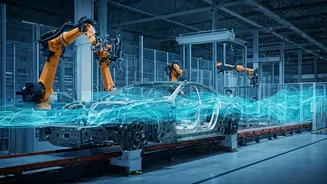
systems. Traditional methods for testing vehicles at the end of the assembly line, often involving manual checks and unique communication methods for different systems, are struggling to keep pace. Vehicles are now packed with advanced features like driver assistance systems, sophisticated battery management for electric cars, and numerous interconnected electronic control units. These intricate setups demand a more advanced and automated approach to diagnostics during production. The sheer volume of vehicles being manufactured means that outdated testing procedures are no longer practical, leading to delays and inefficiencies on high-speed assembly lines. This situation necessitates a fresh approach to ensure quality and speed in vehicle production.
Standardizing Diagnostics
A new standard from ASAM is stepping in to resolve these testing challenges. This innovation introduces a standardized way for diagnostic tools to communicate with vehicle components. It establishes common protocols for data exchange, allowing for real-time, automated checks of critical systems. This means that electronic control units, battery management systems, and other vital parts can be verified automatically and efficiently. By using API-driven interfaces, manufacturers can integrate diagnostic processes directly into their production lines. The result is a dramatic reduction in testing times, potentially from hours down to mere minutes, while also significantly lowering the chances of human error. This is particularly crucial as vehicles become increasingly defined by their software, requiring constant and robust verification throughout the manufacturing process, especially with the advent of over-the-air updates.
Vendor-Agnostic Solutions
This new Diagnostic API promotes a more flexible and competitive environment for testing solutions. It enables the creation of modular diagnostic tools that can work with any vehicle, regardless of who manufactured the components or the testing equipment. This vendor-agnostic approach means that various suppliers and testing equipment providers can develop tools that easily connect to the standardized API. For instance, during the final checks on the assembly line, the API facilitates two-way communication. This allows diagnostic scripts to be run remotely to confirm sensor accuracy, check software integrity, and verify how hardware and software interact. This not only speeds up production throughput but also significantly improves quality assurance, ensuring that every vehicle leaving the factory meets high safety and performance benchmarks.
Industry Impact
The implications of this standardized API are far-reaching for businesses within the automotive sector. Companies that supply production and operations software will need to update their offerings to support this new standard, potentially creating new business opportunities through compatible modules and services. This development also aligns with the broader movement towards digital manufacturing and Industry 4.0, where interconnected systems rely on seamless data sharing. Early adopters, including major car manufacturers in Europe and Asia, are already seeing positive results. They have reported up to a 40% decrease in end-of-line testing expenses and better tracking of vehicle information, which is vital for meeting regulatory requirements. This signifies a substantial shift towards more efficient and traceable manufacturing processes.
Future-Proofing Mobility
ASAM's pioneering work with this Diagnostic API positions it as a key player in setting standards for future automotive technologies, including electric vehicles and autonomous driving. As battery technologies advance, with higher voltages and more complex thermal management systems, the API is designed to be adaptable. It can accommodate emerging needs such as monitoring the health of high-voltage components predictively. For partners in the supply chain, this means quicker integration times when adopting new diagnostic solutions, streamlining logistics and shortening development cycles. It also helps to avoid being locked into proprietary systems, encouraging a more open and innovative market for diagnostic tools. This forward-thinking approach ensures that the industry can adapt to evolving technological landscapes.
Strategic Agility
For automotive manufacturers and major suppliers, embracing this new API is a strategic move towards greater operational flexibility. It provides the scalability needed to ramp up production of next-generation electric and hybrid vehicles, which are expected to have double the electronic complexity by 2030. Research and development teams can also utilize the API for virtual testing simulations, effectively bridging the gap between the design phase and production validation. In regions like Asia, where large-scale manufacturing is prevalent, this standard could foster stronger collaborations between local suppliers and global technology firms, boosting regional competitiveness. Ultimately, this initiative is not just a technical update but a fundamental enabler of operational excellence in an era defined by software in vehicles.