Istanbul's Massive Hub
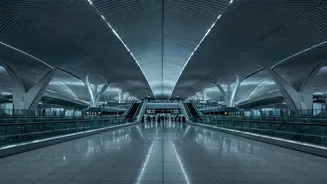
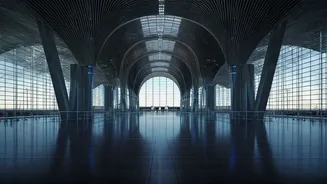
Istanbul Airport (IST) in Turkey is a colossal achievement in aviation infrastructure, featuring a sprawling single-terminal structure, Terminal 1, designed
for phased expansion to become one of the planet's most expansive airport facilities. It proudly stands as the larger of Istanbul's two international gateways, holding the distinction of being Turkey's largest airport overall. Furthermore, it is recognized as the world's largest privately operated airport and ranks as the second-busiest airport across the entire European continent, demonstrating its significant role in global air traffic and economic connectivity. Its ongoing development signifies a commitment to accommodating ever-increasing passenger volumes and enhancing the travel experience through state-of-the-art design and capacity.
Beijing's Starfish Terminal
Beijing Daxing International Airport (PKX) in China is an architectural marvel, celebrated globally as the largest single-building terminal on Earth. Its main structure alone boasts an impressive 700,000 square meters of floor space, a size often likened to approximately 97 football fields. Affectionately nicknamed 'the starfish' due to its unique radial design, this terminal was a monumental construction project, with completion in June 2019 and its operational debut following in September of the same year. Its vastness is a testament to China's rapid growth in air travel and its commitment to creating efficient and expansive hubs for international transit.
Dubai's Former Record Holder
Dubai International Airport's (DXB) Terminal 3 in the United Arab Emirates once commanded the title of the largest airport building in the world, spanning an astonishing 1,185,000 square meters. While some older references may still cite it as the grandest structure, the contemporary recognition for the largest single-roof airport building now often falls to Beijing Daxing. Nevertheless, Terminal 3 remains an immense architectural feat, having opened its doors in October 2008. Its sheer scale underscores Dubai's ambition as a global aviation hub and its continuous efforts to provide unparalleled passenger facilities and capacity for millions of travelers.
Shanghai's Pudong Expansion
Shanghai Pudong International Airport (PVG) in China, which commenced operations in October 1999, is a pivotal gateway for one of the world's busiest cities. Beyond its main terminals, PVG features a satellite terminal that stands out as one of the largest globally, encompassing approximately 622,000 square meters. This expansive facility contributes to PVG's status as the world's second-busiest airport for cargo traffic and the busiest within China. It also ranks as the fourth-busiest in Asia and the tenth-busiest worldwide, highlighting its critical role in international trade and passenger movement.
Jeddah's Hajj Terminal
King Abdulaziz International Airport (JED) in Saudi Arabia serves the important cities of Jeddah and Mecca, with its Terminal 1 being a notable entry among the world's largest single airport buildings. This terminal is specifically engineered to manage exceptionally high passenger volumes, with a particular focus on accommodating the annual Hajj pilgrimage. Its initial design capacity is set for 30 million passengers each year, with ambitious future plans to potentially increase this to an astounding 80 million passengers. This expansion underscores Saudi Arabia's commitment to facilitating religious tourism and enhancing its aviation infrastructure.
Kuala Lumpur's Grandeur
Kuala Lumpur International Airport (KUL) in Malaysia features a significant architectural presence with its very large main terminal complemented by an equally substantial satellite terminal. Terminal 1, which was unveiled in 1998, bears the distinctive design of the renowned Japanese architect Kisho Kurokawa. Interestingly, despite its name, the airport is not situated within the bustling capital city itself but rather in the Sepang District of Selangor. This expansive complex reflects Malaysia's strategic importance as a transit point in Southeast Asia and its dedication to providing world-class airport facilities.
Abu Dhabi's Modern Marvel
Abu Dhabi International Airport (AUH), also known as Zayed International Airport, is the primary international gateway for the capital of the United Arab Emirates. Its newly opened Terminal A, inaugurated in November 2023, is a colossal, modern structure shaped like an X. This immense terminal is designed to handle an impressive 45 million passengers annually and covers an expansive 780,000 square meters, positioning it among the largest airport terminals globally. It's reportedly capable of accommodating up to 79 Airbus A380-type aircraft simultaneously, showcasing cutting-edge design and operational efficiency.