Aurora's Hidden Power
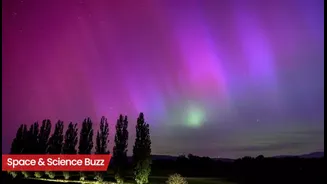
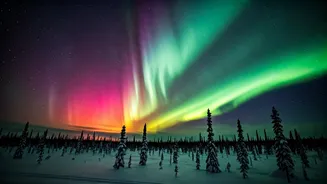
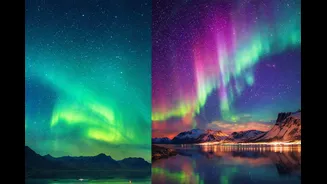
The stunning spectacle of the aurora, often called the northern lights, is a direct result of energetic electrons descending from space and interacting
with Earth's atmosphere. These charged particles, rather than falling in a straight line, are guided by magnetic fields and often follow intricate, circuitous paths. Understanding the precise pathways and intensity of these electrical currents is crucial because they act as conduits for energy transfer into the upper atmosphere. This energy transfer can lead to atmospheric heating and turbulence, which, in turn, can disrupt the operations of vital satellite systems. The GNEISS mission is specifically designed to illuminate these elusive currents, providing an unprecedented view of the forces that create the aurora. By mapping these electrical pathways, scientists hope to gain a deeper insight into the complex dynamics of space weather, a phenomenon that affects everything from communication systems to navigation.
GNEISS Mission Unveiled
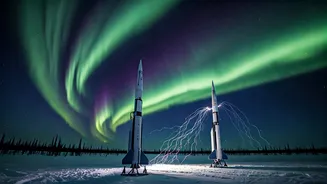
Scheduled for an early February 2026 launch from Poker Flat, Alaska, the Geophysical Non-Equilibrium Ionospheric System Science (GNEISS) mission is NASA's ambitious endeavor to chart the electrical currents powering the aurora. This sophisticated mission will deploy two rockets, each carrying multiple sub-payloads. The core of the GNEISS technique involves a method remarkably similar to a CT scan. As the sub-payloads transmit radio signals towards receivers on the ground, the intervening plasma—the electrically charged gas in the ionosphere—interferes with these signals. By meticulously analyzing how the plasma affects the radio waves, scientists can effectively reconstruct a three-dimensional map of the electron density and the direction of their flow, much like how medical imaging uses tissue density to create an image of the human body. This innovative approach promises to provide a level of detail about auroral currents previously unattainable.
Space Weather Insights
The data gathered by the GNEISS mission will have significant implications for our understanding and prediction of space weather. The electrical currents associated with auroras are not just visually striking; they are instrumental in directing energy into the Earth's upper atmosphere. This influx of energy can cause significant heating and atmospheric disturbances, posing a risk to the functionality and longevity of satellites orbiting our planet. By integrating the detailed measurements from GNEISS with observations from NASA's existing satellite network, launched in March 2025, scientists aim to develop more accurate predictive models for aurora-related space weather events. Furthermore, NASA is planning an additional rocket mission to investigate what are known as 'black auroras' – regions of darkness within the auroral display. These dark patches are believed to signify points where the electrical current flow reverses, offering another critical piece of the puzzle in understanding the intricate electrical dynamics of our planet's magnetosphere.