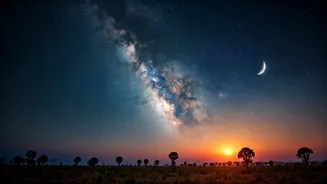
The Pink Moon Appears
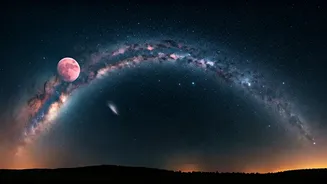
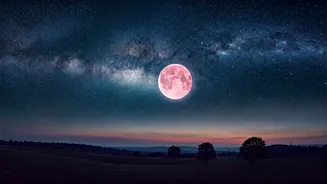
April 1st, 2026, will be graced by the first full moon of spring, an event known as the Pink Moon. This luminous celestial body will reach its peak fullness
at 10:12 PM ET. Its name doesn't signify a color change; rather, it's a nod to the moss pink flowers that blossom in North America during this season. Adding to its allure, this full moon will be exceptionally beautiful as it positions itself near its closest orbital point to Earth, resulting in a 'supermoon' effect that makes it appear approximately 15% brighter and slightly larger than its typical presentation. This enhanced visibility makes it a prime opportunity for observing the moon's surface details.
Mercury Peaks in Sky
On April 3rd, 2026, Mercury will achieve its greatest western elongation, meaning it will be at its farthest point from the Sun as viewed from Earth, situated in the pre-dawn sky. This particular configuration is significant because Mercury, being the closest planet to the Sun, is often obscured by its intense glare, making it challenging to observe. This alignment, however, will position Mercury favorably in the eastern horizon just before sunrise, offering astronomers a more accessible window to study its surface features and its remarkably thin atmosphere. This event provides a rare chance to catch a glimpse of the elusive inner planet.
Comet C/2026 A1 Nears
Mark your calendars for April 4th, 2026, as Comet C/2026 A1 (MAPS) undertakes a close encounter with the Sun, passing a mere 850,000 miles away. This 'sun-grazing' maneuver will subject the comet to intense solar heat, causing its icy composition to sublimate and transform into gas. This process will generate a brilliant, glowing coma and a prominent tail. Should the comet maintain its structural integrity during this close approach, it holds the potential to evolve into a spectacular 'Great Comet,' becoming a breathtaking sight visible in the morning sky for keen observers. Its visibility will depend on its behavior and trajectory as it navigates near our star.
Planetary Alignment Dawn
Between April 16th and 23rd, 2026, a remarkable celestial gathering will unfold in the pre-dawn sky: a 'planet parade.' Mercury, Mars, Saturn, and Neptune will appear remarkably close to one another, creating a rare and stunning alignment. While they may seem intimately clustered from our perspective on Earth, it's important to remember that these planets remain separated by millions of miles in reality. Such planetary conjunctions are invaluable not only for the aesthetic beauty they offer but also for the scientific opportunities they present, aiding astronomers in their studies of the solar system and the calibration of observational instruments.
Moon, Venus, Pleiades Unite
The nights of April 18th and 19th, 2026, promise a captivating visual spectacle as the Moon, Venus, and the enchanting Pleiades star cluster converge in close proximity. This conjunction offers a beautiful tableau in the sky, appealing to both casual observers who appreciate celestial aesthetics and dedicated astronomers. For those studying the intricate dance of planetary and stellar movements, such close groupings provide valuable opportunities to track and analyze the dynamics of our solar system and beyond, offering a unique perspective on their orbital paths and relative positions.
Lyrid Meteor Shower Peaks
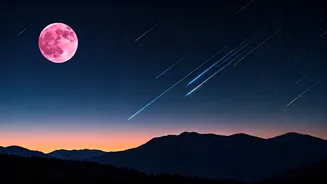
The annual Lyrid meteor shower will reach its zenith on April 22nd and 23rd, 2026, offering a shower of shooting stars. This display originates from the cosmic dust trail left behind by Comet Thatcher. As our planet traverses this stream of debris, tiny particles enter Earth's atmosphere at an astonishing speed of 110,000 miles per hour, igniting and creating brilliant streaks of light across the night sky. The Lyrids have a long observational history, dating back over 2,700 years, making it one of the oldest documented meteor showers known to humanity.
Whirlpool Galaxy Shines
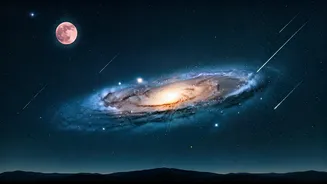
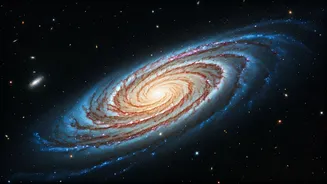
Throughout April 2026, the magnificent Whirlpool Galaxy, also cataloged as Messier 51, will be at its most favorable position for viewing. Situated approximately 31 million light-years from Earth, this majestic spiral galaxy is currently engaged in a gravitational interaction with a smaller companion galaxy, NGC 5195. This cosmic pairing provides astronomers with an exceptional opportunity to investigate the intricate processes of star formation occurring within the graceful spiral arms of the larger galaxy, offering profound insights into galactic evolution.
Northern Lights Fade
As April 2026 draws to a close, the traditional season for observing the Northern Lights begins to wane in the Northern Hemisphere. The increasing hours of daylight and brighter skies associated with the transition to warmer weather will progressively obscure the faint glow of the aurora borealis. Despite the continued solar activity that fuels these ethereal displays, their visibility will diminish, marking the end of the aurora season for regions situated near the Arctic Circle. This signifies a natural shift in atmospheric conditions that impacts the perception of these natural light shows.