Practical Beginnings
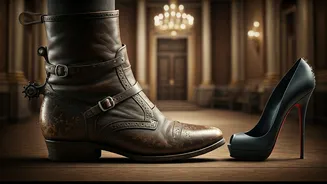
The high heel's story doesn't begin in glamorous ballrooms, but rather on the backs of horses. In the 15th century, Persian cavalry utilized heels to anchor
their feet firmly in stirrups, providing essential stability for combat and maneuvering. This functional design, integrated into robust boots, laid the groundwork for what would later become recognizable as the cowboy boot. The concept of elevation gradually seeped into fashion, but its initial purpose was purely utilitarian. Across Europe in subsequent centuries, this practical elevation was adapted for different needs. In Spain, wooden or cork soles, known as chopines, helped women navigate the muddy, unsanitary streets. As these elevated shoes travelled, particularly to Venice through diplomatic exchanges, their height increased, often adorned with luxurious fabrics like velvet. This change transformed the act of walking into a deliberate, slow display, signaling a life removed from manual labor and associated with privilege. The very impracticality of these towering footwear became a marker of status, suggesting wearers relied on others for assistance and transport.
Status and Power
The evolution of heels saw them solidify their role as potent symbols of power and social standing. By the 17th century, in France, King Louis XIV famously embraced heels, often sporting four-inch versions. His decree that only members of the royal court could wear red-soled shoes further cemented this footwear as a visual hierarchy, a clear indicator of proximity to the throne and elevated status. This association with authority wasn't confined to European royalty. Across the globe, cultures developed their own forms of elevated footwear that conveyed meaning. In Japan, the wooden geta and lacquered okobo created distinctive sounds with each step, turning movement into a form of ceremony. Similarly, Ottoman kabkabs, often worn in bathhouses, combined practical elevation with intricate ornamentation. While not direct ancestors of modern heels, these global examples illustrate a shared human inclination to use footwear to express cultural identity, social position, and even ritualistic significance.
Technological Leaps
The mid-19th century marked a pivotal moment in heel evolution with a significant technological breakthrough: the introduction of the steel shank. This innovation revolutionized shoe construction by providing crucial internal support, allowing for greater height and stability than previously possible. This development paved the way for the sleeker, more precarious heel designs that would emerge later, including the iconic stiletto. The 20th century saw further experimentation and refinement. Designers began to explore new materials and forms to push the boundaries of footwear. In the 1940s, Salvatore Ferragamo innovated with lightweight cork wedges and transparent sandals, focusing on balance and comfort alongside style. Later, in 1954, Roger Vivier introduced the modern stiletto, a masterpiece of engineering and elegance that would define glamour for decades. The 1970s brought a resurgence of dramatically elevated footwear with the widespread adoption of platform shoes, becoming synonymous with the flamboyant aesthetics of glam rock, disco, and vibrant queer nightlife scenes, where height was a form of theatrical self-expression and bold identity.
Fashion's Language
In recent decades, high heels have transcended mere accessory status to become powerful elements of cultural language, conveying sophisticated messages of status, artistry, and evolving notions of femininity. The 2000s saw the emergence of the iconic red sole, famously associated with a prominent designer. This bold splash of color became an instantly recognizable marker of luxury, proving that a distinctive visual cue alone could communicate prestige without explicit branding. In a more avant-garde vein, the Margiela Tabi heel, originally inspired by Japanese workwear and reintroduced in the 2010s, gained cult status as a symbol of fashion insider knowledge and a more conceptual approach to design. Further pushing the boundaries of form and spectacle, Alexander McQueen's Armadillo boots in 2010 transformed footwear into wearable art, notably adopted by Lady Gaga, signaling fashion's embrace of the dramatic and the post-human. Contemporary designers continue to reinterpret the heel, with brands like Prada and Miu Miu exploring industrial aesthetics and playful proportions, reframing femininity as intelligent, ironic, and self-aware, demonstrating the enduring power of heels to communicate complex ideas and individual style.