
'%3e%3cpath%20fill-rule='evenodd'%20clip-rule='evenodd'%20d='M6%200C10.4183%200%2014%203.58171%2014%207.99999V14.0003C14%2018.4186%2017.5817%2022.0003%2022%2022.0003H122C126.418%2022.0003%20130%2018.4186%20130%2014.0003V8C130%203.58172%20133.582%200%20138%200H6Z'%20fill='%23EDF2E7'/%3e%3c/g%3e%3cdefs%3e%3cfilter%20id='filter0_d_12223_4749'%20x='0'%20y='0'%20width='144'%20height='36'%20filterUnits='userSpaceOnUse'%20color-interpolation-filters='sRGB'%3e%3cfeFlood%20flood-opacity='0'%20result='BackgroundImageFix'/%3e%3cfeColorMatrix%20in='SourceAlpha'%20type='matrix'%20values='0%200%200%200%200%200%200%200%200%200%200%200%200%200%200%200%200%200%20127%200'%20result='hardAlpha'/%3e%3cfeOffset%20dy='8'/%3e%3cfeGaussianBlur%20stdDeviation='3'/%3e%3cfeComposite%20in2='hardAlpha'%20operator='out'/%3e%3cfeColorMatrix%20type='matrix'%20values='0%200%200%200%200.356863%200%200%200%200%200.427451%200%200%200%200%200.270588%200%200%200%200.7%200'/%3e%3cfeBlend%20mode='normal'%20in2='BackgroundImageFix'%20result='effect1_dropShadow_12223_4749'/%3e%3cfeBlend%20mode='normal'%20in='SourceGraphic'%20in2='effect1_dropShadow_12223_4749'%20result='shape'/%3e%3c/filter%3e%3c/defs%3e%3c/svg%3e)
Celestial Traffic Control
SpaceX has introduced a groundbreaking system named Stargaze, designed to actively prevent dangerous collisions in Earth's orbit. This ingenious technology
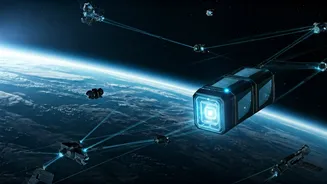
leverages the 30,000 star trackers already integrated into its Starlink satellite constellation. These trackers are not just for navigation; they form a vast, interconnected network constantly surveying the surrounding space. On a daily basis, this fleet detects approximately 30 million transits, essentially observing millions of objects moving across the sky. This continuous monitoring allows Stargaze to identify potential space traffic jams, offering a proactive solution to the growing challenge of orbital debris and satellite proximity. By processing this immense volume of data, the system can predict and flag potential impacts well in advance, significantly enhancing the safety and sustainability of space operations.
Swift Collision Alerts
The operational mechanism of Stargaze is built on speed and efficiency. The star trackers embedded in the satellites continuously scan their environment, acting like miniature celestial eyes. When they detect an object that poses a risk of collision, the system immediately generates alerts. These alerts, known as Collision Detection and Mitigation (CDM) messages, are transmitted with remarkable speed. Unlike older methods that might take hours to receive updates from ground-based stations, Stargaze provides these warnings in mere minutes. This drastic reduction in alert time gives satellite operators significantly more opportunity to maneuver their spacecraft and avert potential disasters. It transforms the reactive approach to collision avoidance into a proactive and rapid response system, ensuring greater safety.
Prompted by Near-Miss
The impetus behind the development of Stargaze was a critical incident that occurred last year. During this event, one of SpaceX's satellites unexpectedly had to make a sudden maneuver to avoid a close encounter with another orbiting object. This near-miss highlighted the urgent need for a more responsive and integrated collision avoidance system. Fortunately, the very system that would become Stargaze was able to detect the unexpected trajectory of the other satellite and issue a timely alert. Thanks to this swift warning, the Starlink satellite was able to adjust its path and avoid a catastrophic collision within an hour of the alert being issued. Following successful testing with a select group of partners, SpaceX is preparing for a broader implementation of Stargaze in the upcoming weeks. The company plans to offer free collision alerts to operators who share their orbital data (ephemeris), with the system's own ephemeris being updated on an hourly basis.