Celestial Visitors Emerge
Interstellar visitor 3I/ATLAS has captivated astronomers with its comet-like appearance and behavior, as newly released images from NASA satellites showcase
its journey across our solar system. These observations, gathered from various vantage points, provide an unprecedented look at an object originating from beyond our Sun's influence. The detailed imagery helps scientists understand the composition and evolution of comets, particularly those not formed within our own cosmic neighborhood. This ongoing study of 3I/ATLAS promises to deepen our understanding of planetary formation and the vast, diverse nature of celestial bodies that traverse the galaxy. The data collected is crucial for distinguishing between objects born in our solar system and those from distant star systems, offering insights into the unique conditions that shape each.
Earth's Fiery Embrace
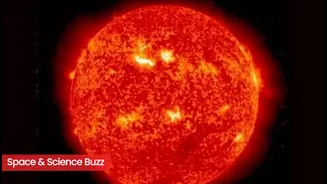
Our planet frequently experiences dramatic interactions with solar activity. Massive Coronal Mass Ejections (CMEs) from the Sun have slammed into Earth's magnetic field, triggering intense geomagnetic storms. These events have a profound impact, leading to spectacular auroral displays visible in numerous states across the United States, sometimes reaching far lower latitudes than usual. For instance, on January 19th, the Northern Lights were predicted in 24 states, and a subsequent CME on January 20th caused Earth's magnetic field to 'ring like a bell,' again facilitating aurora sightings. Beyond these visual spectacles, these powerful solar events can disrupt radio communications, leading to blackouts, as was observed across Africa and Europe following the strongest solar flare of 2025. The strongest solar radiation storm in over two decades also impacted Earth, underscoring the potent forces at play.
Ice and Water's Dance
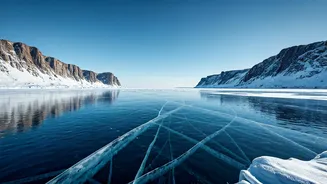
Satellite perspectives offer a unique view of Earth's dynamic water systems and icy domains. A 40-year-old iceberg was recently observed melting and transforming, its surface changing from white to a striking blue as it receded, a stark visual testament to climate shifts. Greenland's snow-covered peaks have been repeatedly captured from space, showcasing the vastness of its frozen landscape. Similarly, Antarctica's subglacial surface is being mapped with unprecedented detail, thanks to satellite technology that peers beneath the ice. On a different scale, satellites are also monitoring rivers as they flow across the globe, illustrating patterns of water distribution and change. These observations are vital for understanding the health of our planet's cryosphere and its vital water resources.
Atmospheric Phenomena Observed
The complex interplay between Earth's atmosphere and climate gives rise to significant weather events, often monitored by satellites. January's polar vortex, a swirling mass of cold air, was observed by NASA satellites, highlighting its powerful influence on weather patterns. The concept of atmospheric science is crucial here, as these phenomena are direct results of these interactions. Even distant planets like Jupiter and Saturn exhibit mysterious polar weather, offering clues about their internal structures and atmospheric dynamics. On Earth, jet streams play a critical role in distributing heat and influencing weather systems. These observations contribute to our understanding of climate variability and the forces that shape weather on both our planet and others.
Landscapes Reshaped by Nature
From dramatic geological formations to the destructive power of extreme weather, satellites capture nature's artistry and fury. A Canadian crater is noted for its striking resemblance to marbled meat, a unique visual sculpted by geological processes. Satellites have also documented the destructive might of Hurricane Melissa, illustrating the devastating impact of powerful storms. Furthermore, natural forces can create astonishing formations, such as a colossal snowman carved by nature in Siberia. These images remind us of the constant reshaping of Earth's surface by both slow geological processes and rapid weather events, providing a unique perspective on our planet's ever-evolving geography.