Dark Matter Mysteries Deepen
The fundamental nature of dark matter, a substance composing approximately 85% of the universe's mass, remains one of cosmology's most profound puzzles.
While its gravitational influence is observable through galactic rotation curves and gravitational lensing, its composition eludes direct detection. Recent theoretical frameworks suggest that dark matter might not be a distinct particle but rather a manifestation of gravity itself behaving differently at vast scales, a departure from Einstein's general relativity. This radical idea, if proven, would necessitate a significant revision of our understanding of fundamental physics and the cosmos. Simultaneously, advanced instruments like the James Webb Space Telescope are providing unprecedentedly detailed views of the universe, mapping the distribution of dark matter across vast cosmic structures and offering new clues to its identity. These observations, painting a clearer picture of the dark universe, are bringing long-held scientific dreams closer to reality, pushing the boundaries of our cosmic comprehension.
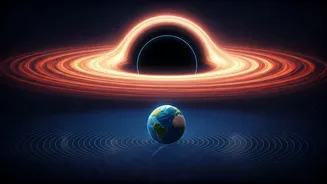
Black Hole Power Unleashed
The immense power emanating from supermassive black holes continues to astound scientists. Jets of high-energy particles, propelled at near light speed from the vicinity of these cosmic behemoths, exhibit energies that dwarf even fictional superweapons. The recent observation of a particularly potent jet from a black hole demonstrates a force far exceeding that of the Death Star's laser, highlighting the extreme astrophysical phenomena at play in the universe. Furthermore, scientists are exploring the origins of cosmic rays, with the possibility that an 'impossible' particle detected on Earth in 2023 could be linked to the explosive death of a black hole. Understanding these events, including the violent collision of neutron stars simulated by NASA, is crucial for deciphering the universe's most energetic processes and potentially revealing secrets about exotic particles.
Space Exploration's Hurdles
The future of space exploration is being shaped by a complex interplay of ambition, technological advancement, and significant challenges, including budget constraints and the growing problem of space debris. While Europe is bolstering its space budget, NASA faces considerable cuts, potentially impacting collaborative missions like Europe's next Venus exploration effort. The proliferation of satellites, such as those in low Earth orbit beaming internet, raises concerns for astronomical research due to their brightness. Moreover, the increasing amount of space debris poses a growing threat, leading to orbital emergencies and near-misses with airplanes. The risk of catastrophic collisions necessitates international cooperation and robust solutions to mitigate this hazard before a major disaster compels action. These issues underscore the delicate balance between expanding our presence in space and ensuring its long-term sustainability for scientific endeavors and future human endeavors.
Innovations for the Final Frontier
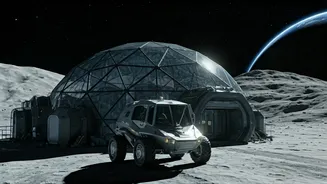
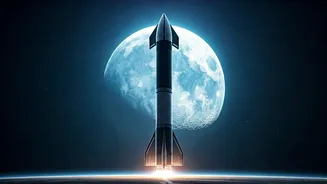
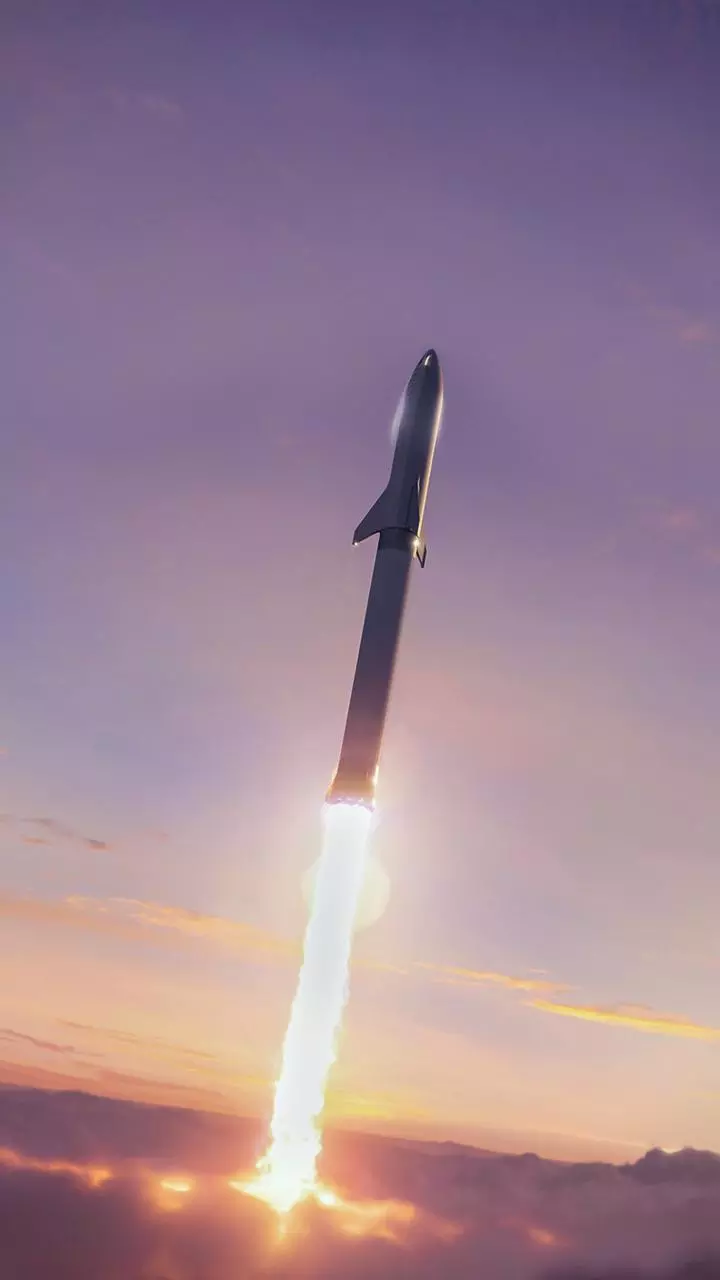
As humanity looks towards establishing a presence beyond Earth, innovative solutions are being explored for life and infrastructure in space. On Mars, the presence of a potentially toxic chemical in the Martian soil is being investigated as a possible resource for constructing habitats, a novel approach to in-situ resource utilization. The prospect of human reproduction in space is also becoming a serious topic of discussion among scientists, anticipating the long-term needs for off-world colonization. Furthermore, the development of superheavy-lift rockets like SpaceX's Starship promises to revolutionize astronomy by significantly reducing the cost of launching massive space telescopes, thereby democratizing access to deep-space observation. Meanwhile, earthquake sensors are proving surprisingly adept at tracking space junk re-entering Earth's atmosphere, offering a unique method for monitoring hazardous orbital debris.