
'%3e%3cpath%20fill-rule='evenodd'%20clip-rule='evenodd'%20d='M6%200C10.4183%200%2014%203.58171%2014%207.99999V14.0003C14%2018.4186%2017.5817%2022.0003%2022%2022.0003H122C126.418%2022.0003%20130%2018.4186%20130%2014.0003V8C130%203.58172%20133.582%200%20138%200H6Z'%20fill='%23EDF2E7'/%3e%3c/g%3e%3cdefs%3e%3cfilter%20id='filter0_d_12223_4749'%20x='0'%20y='0'%20width='144'%20height='36'%20filterUnits='userSpaceOnUse'%20color-interpolation-filters='sRGB'%3e%3cfeFlood%20flood-opacity='0'%20result='BackgroundImageFix'/%3e%3cfeColorMatrix%20in='SourceAlpha'%20type='matrix'%20values='0%200%200%200%200%200%200%200%200%200%200%200%200%200%200%200%200%200%20127%200'%20result='hardAlpha'/%3e%3cfeOffset%20dy='8'/%3e%3cfeGaussianBlur%20stdDeviation='3'/%3e%3cfeComposite%20in2='hardAlpha'%20operator='out'/%3e%3cfeColorMatrix%20type='matrix'%20values='0%200%200%200%200.356863%200%200%200%200%200.427451%200%200%200%200%200.270588%200%200%200%200.7%200'/%3e%3cfeBlend%20mode='normal'%20in2='BackgroundImageFix'%20result='effect1_dropShadow_12223_4749'/%3e%3cfeBlend%20mode='normal'%20in='SourceGraphic'%20in2='effect1_dropShadow_12223_4749'%20result='shape'/%3e%3c/filter%3e%3c/defs%3e%3c/svg%3e)
Fuel Costs Soar
Commercial aviation faces a substantial financial burden due to escalating fuel expenses. In 2024, airlines are estimated to have spent a staggering $291
billion on fuel, an increase from $271 billion in 2023. Projections suggest this figure likely climbed even higher in 2025. These ever-increasing costs place immense pressure on airline profitability and impact ticket prices for passengers. The constant need to manage and mitigate these expenditures is a critical challenge for the industry, driving a continuous search for innovative solutions that can enhance operational efficiency and reduce financial outlays.
Innovative Wing Design
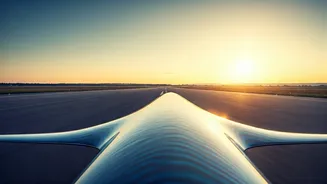
NASA has unveiled a potentially game-changing wing technology, the Crossflow Attenuated Natural Laminar Flow (CATNLF) concept, which aims to dramatically lower aerodynamic drag. During recent tests, a NASA research jet, equipped with a scale model of this novel design, achieved a remarkable speed of 144 mph solely on the runway. This crucial test involved affixing a 3-foot-tall model of the CATNLF concept beneath a research aircraft, allowing engineers to subject it to authentic airflow conditions without the complexities of developing a full-scale wing or a new test plane. The design is notably distinct, featuring a narrow, vertically oriented fin rather than the conventional horizontal wing structure.
The Science of Drag Reduction
At its heart, the CATNLF concept addresses a persistent issue in aerodynamics: the management of the thin layer of air, known as the boundary layer, that adheres to an aircraft's surface during flight. This layer, often turbulent, creates friction and drag, necessitating more fuel expenditure to maintain speed and lift. NASA's innovative approach makes it more difficult for this air layer to cling to the aircraft, thereby minimizing friction and enhancing overall aerodynamic efficiency. This principle is supported by years of extensive computer modeling and wind tunnel research, which indicated that the CATNLF concept could potentially reduce annual fuel consumption by up to 10 percent for commercial aircraft.
Potential Savings and Impact
The projected 10 percent fuel efficiency improvement offered by NASA's CATNLF technology could translate into tens of billions of dollars in annual savings for the airline industry, based on historical fuel expenditure figures. While this represents a best-case scenario, even modest gains in efficiency can yield hundreds of millions in savings globally. Beyond the economic benefits, this advancement also carries significant environmental implications, promising a reduction in aviation's carbon footprint through decreased emissions. The successful high-speed taxi tests are just the initial step, paving the way for upcoming flight evaluations where the CATNLF model will be tested in actual flight conditions aboard an F-15B aircraft.
Future Applications
While the immediate focus of the CATNLF technology is on improving the efficiency of commercial airliners, NASA researchers foresee its potential application to supersonic aircraft in the future. Adapting these principles for high-speed flight could unlock significant efficiency gains at much faster speeds. This could open new avenues for designing faster and more economical long-distance travel. For the present, however, the primary objective remains to leverage this innovation within the commercial aviation sector, where the potential for widespread economic and environmental benefits is most pronounced, offering a tangible pathway to more sustainable and cost-effective air travel.