Cosmic Nursery Revealed
In a remarkable astronomical feat, scientists have directly imaged a second protoplanet actively forming around the infant star WISPIT 2. This exciting
development follows the initial detection of a protoplanet in the same system last year. The WISPIT 2 system now stands as a rare cosmic stage, alongside PDS 70, where multiple planets in their nascent stages have been visually confirmed. The star's surrounding disk, characterized by distinct gaps and rings, strongly suggests the ongoing assembly of additional planets, which future observations may bring to light. Researchers believe that WISPIT 2's early environment might mirror the turbulent beginnings of our own solar system.
Planetary Giants Emerge
The newly identified celestial body, christened WISPIT 2c, is a colossal gas giant, estimated to possess roughly four times the mass of Jupiter. It orbits its parent star much closer than its sibling, WISPIT 2b, which is about 60 astronomical units (AU) away from the star, with one AU equaling the distance between the Earth and the Sun. WISPIT 2c orbits its star at half the distance of WISPIT 2b and is twice as massive. Both WISPIT 2b and WISPIT 2c are classified as gas giants, akin to the massive planets Jupiter and Saturn in our own solar system. Follow-up investigations have rigorously confirmed that these objects are indeed exoplanets.
Hints of a Third World
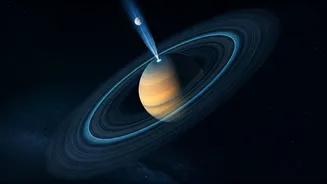
The process of star and planet formation begins within dense molecular clouds, where gravity pulls together surrounding gas and dust. This accumulation continues until the core reaches sufficient temperature and pressure to ignite nuclear fusion, marking the birth of a star. The planets themselves coalesce from the leftover material in the disk orbiting the young star. As these forming planets sweep up their environment, they carve out noticeable gaps within this circumstellar disk. Both WISPIT 2b and WISPIT 2c have been observed within distinct clearings in the protoplanetary disk. Intriguingly, a third gap is also present in the disk, leading astronomers to speculate that another protoplanet might be concealed within this region, awaiting discovery in forthcoming observations.